Can slicing a company’s shares actually lift the stock price?
Short answer: yes, usually a near-term pop, not a lasting change in value.
On announcement day stocks often jump about 2 percent to 5 percent and volume spikes as retail traders, momentum algos, and news attention rush in.
Thesis: a split is a catalyst that signals management confidence and boosts accessibility, so watch the announcement, the execution date, volume, and market context. If broader sentiment is weak or fundamentals disappoint, the initial bump often fades.
Immediate Market Reaction After a Stock Split Announcement

When a company announces a stock split, the market usually responds with an immediate upward move in share price, averaging somewhere between 2 percent and 5 percent on the announcement day. This reaction unfolds quickly. Often within the first few trading hours, as algorithms, momentum traders, and retail investors react to the news. Trading volume typically surges by 50 percent to 200 percent above normal intraday levels, signaling heightened interest and active repositioning.
The strongest price gains tend to concentrate in the first three trading days after the announcement. Cumulative abnormal returns in the 1 to 30 trading day window after announcement commonly fall between 3 percent and 10 percent, with the median outcome closer to the lower end. Not every split announcement produces a pop. Companies announcing splits during broader market corrections or those with weak fundamentals may see muted or even negative reactions, proving that sentiment and context matter as much as the split itself.
Investor behavior during this window gets driven by several factors. Speculation around retail accessibility, momentum chasing, and positive signaling from management all contribute to the initial move. Many traders treat split announcements as short term catalysts and look to capture a quick gain, knowing that history suggests a near term edge exists.
Key characteristics of the immediate reaction include:
- Average announcement day gain of roughly 2 percent to 5 percent
- Volume spike ranging from 50 percent to 200 percent above normal
- Strongest cumulative returns in the first 0 to 3 trading days
- Positive abnormal return concentrated around the announcement session
- Higher intraday volatility as momentum and retail traders enter positions
Why Stock Prices React to Split Announcements

Stock split announcements carry an implied signal that management expects continued strong performance and wants to make shares more accessible. When executives choose to split, they’re effectively saying they believe the stock price will remain elevated or continue rising. Otherwise the cosmetic adjustment wouldn’t make sense. Investors interpret this as confidence, and that perception alone can trigger buying pressure even though the split creates no new cash flow or earnings.
Behavioral dynamics amplify the move. Lower nominal prices attract retail investors who prefer holding round lots or perceive cheaper shares as more affordable, even though the total investment amount stays identical. Herd behavior kicks in as momentum traders see the early pop and pile in, expecting the move to continue. Anticipated liquidity improvements also matter. A higher share count and lower per share price can tighten bid ask spreads, improve market making depth, and make the stock more attractive to index funds, ETFs, and derivative traders who favor liquid names. The announcement itself acts as a narrative catalyst, drawing media coverage and social media buzz that extends the attention cycle and pulls in speculative interest.
Announcement Day vs. Execution Day Movements
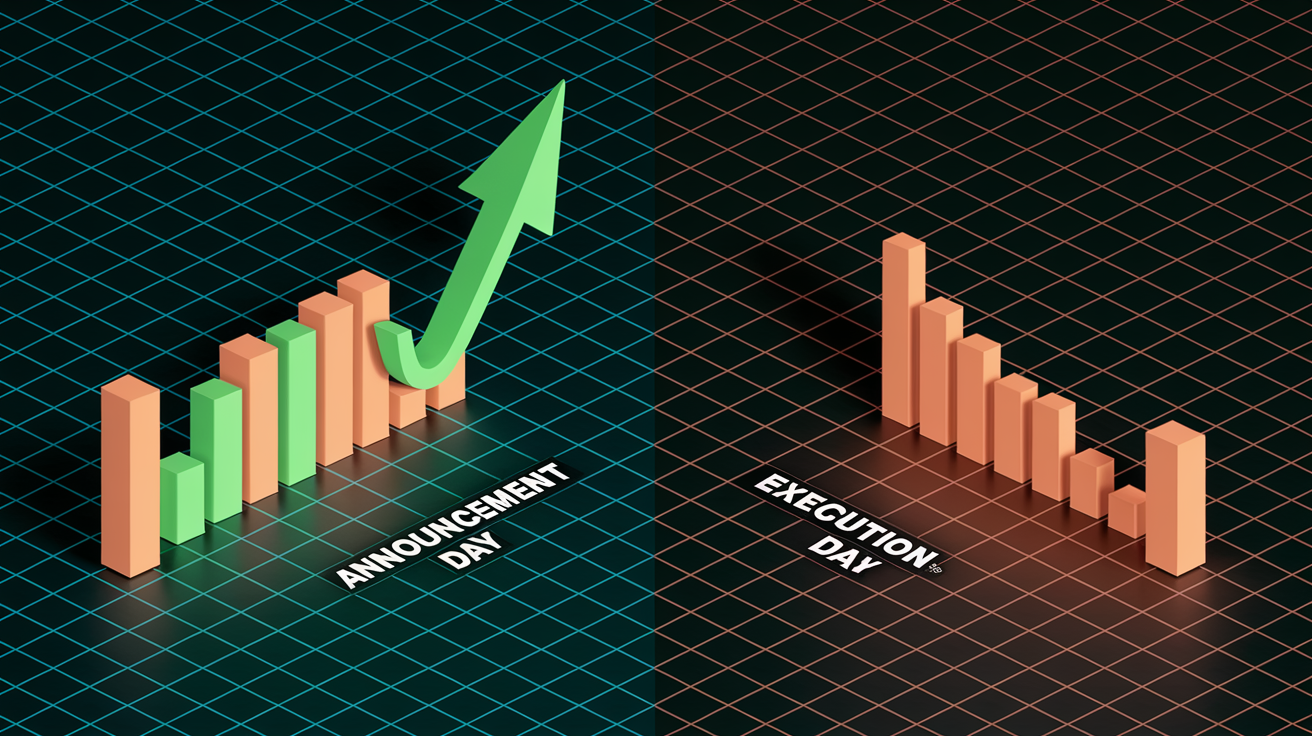
The announcement day is where most of the action happens. Prices jump, volume spikes, and the stock often trends higher for a few sessions as the market digests the news and speculators position for follow through. The execution date, or effective date, when shares are actually split and the per share price gets adjusted down mechanically, tends to produce much smaller moves or even mixed results. By that point, most of the announcement premium has already been priced in, and the actual split becomes a non event from a value perspective.
Traders often reposition in the days leading up to execution. Some take profits after the initial run, others add exposure hoping for a final pop. Once the split becomes effective, the lower nominal price can attract a fresh wave of retail buyers. But institutional flows and algorithmic rebalancing can also introduce volatility or profit taking that mutes any sustained rally.
| Event | Typical Price Reaction | Volume Behavior |
|---|---|---|
| Announcement Day | +2% to +5% median jump; strongest single day gain | Volume surge of 50% to 200% above normal |
| Days 1–10 After Announcement | Cumulative gain often +3% to +10%; momentum fades | Elevated but declining; typically 20% to 50% above baseline |
| Execution/Effective Date | Mixed or muted; mechanical price adjustment; limited abnormal return | May see temporary spike from retail; often normalizes quickly |
Historical Patterns and Real World Examples
Apple’s 4 for 1 split announcement on July 30, 2020 offers a textbook case. The stock jumped on the news and continued to climb into the split month, benefiting from momentum, retail enthusiasm, and positive tech sector sentiment. Trading volume spiked materially, and the move reinforced investor confidence heading into the execution date on August 28, 2020. The pattern was clear: announcement, immediate rally, sustained strength for weeks.
Tesla’s 5 for 1 split announcement on August 11, 2020 produced a similar outcome. Shares surged in the low double digit percentage range within days, driven by retail momentum and heavy social media attention. The company was already riding a strong 2020 rally, and the split announcement added fuel. Volume exploded, and the stock maintained elevated levels through the effective date and beyond, showing how splits can amplify existing momentum when fundamentals and sentiment align.
Nvidia announced a 10 for 1 split effective June 7, 2024, after shares had climbed above 1,200 dollars. The announcement drew significant attention, and the stock showed positive movement around the news. But the company had already delivered explosive gains in 2023, rising roughly 240 percent, so the split itself represented more of a liquidity and accessibility play than a new catalyst. The post announcement move was constructive but relatively modest compared to the prior run, demonstrating that context and timing shape how splits perform.
Notable split announcement reactions include:
- Apple (4 for 1, July 2020): immediate multi percent jump; sustained strength into execution
- Tesla (5 for 1, August 2020): low double digit percentage gain in first few days; heavy retail participation
- Nvidia (10 for 1, June 2024): positive reaction; modest move relative to prior year’s surge
- Amazon (20 for 1, June 2022): solid announcement day pop; choppy follow through in mixed market
Do Stock Splits Create Real Value?

Stock splits don’t change a company’s market capitalization or intrinsic value. The math is straightforward: if you own 1,000 shares at 200 dollars each, your position is worth 200,000 dollars. After a 2 for 1 split, you own 2,000 shares at 100 dollars each, still worth 200,000 dollars. The split simply rearranges the share count and per share price without altering cash flow, earnings, or assets. From a fundamental perspective, splits are cosmetic.
What splits can do is improve liquidity and accessibility. A lower per share price reduces the perceived barrier to entry for retail investors, especially those who prefer to buy round lots or who trade on platforms that don’t offer fractional shares. Higher share counts can tighten bid ask spreads, increase market making depth, and make the stock more attractive to index funds and ETF providers that favor liquid names. These liquidity effects can support near term price momentum and may contribute to sustained outperformance if the company’s fundamentals remain strong. However, long term abnormal returns from splits tend to disappear once you control for size, momentum, and underlying business performance, meaning the split itself isn’t the driver of lasting value creation. The psychological appeal, signaling effect, and short term trading dynamics matter, but they don’t replace the need for solid fundamentals and favorable market conditions.
Final Words
Stocks often pop 2–5 percent and see a volume spike in the hours and days after a split is announced.
That reaction comes from signaling, retail interest, and the promise of better liquidity. It’s usually clearest on announcement day. Execution day often calms.
So make a plan. Note an entry, watch volume and momentum, set an invalidation level, and size for volatility.
If you want the short answer to what happens to stock price after stock split announcement, expect a short-term lift for many names but not a lasting value change. Stick to the levels and you’ll benefit.
FAQ
Q: Does stock price go up after stock split?
A: Stock prices often rise after a stock split announcement, typically 2 to 5 percent in the days that follow, driven by higher volume and retail interest, but gains aren’t guaranteed and depend on fundamentals.
Q: What is the 7% rule in stocks?
A: The 7 percent rule in stocks isn’t universal. Many traders use a 7 percent stop-loss or position-size guideline, selling or trimming after a 7 percent drop to limit losses.
Q: Is it better to buy a stock before or after a split?
A: Whether to buy before or after a split depends on your plan. Traders may buy on the announcement for momentum; long-term investors usually wait for post-split confirmation and cleaner risk levels.
Q: What is the downside of a stock split?
A: The downside of a stock split is it doesn’t change fundamentals or market cap; it can invite speculation, higher short-term volatility, and unrealistic expectations that can lead to bad timing.