
Ever wonder why a stock can jump 8 percent at the open without trading at the prices in between?
It’s not magic. It’s news and order flow.
Gaps form when after-hours catalysts (earnings, analyst upgrades, press releases) and overnight futures moves attract far more buyers than sellers before the 9:30 a.m. opening auction (the process that matches orders).
The auction sets the opening price, so a big buy imbalance creates a gap.
Watch pre-market quotes, futures, and the opening imbalance on your watchlist; if sellers step in, the gap often fills.
Core Reasons Stocks Gap Up at the Market Open

A price gap happens when a stock opens noticeably higher than where it closed the day before, leaving blank space on the chart because no trades occurred at the prices in between. Between sessions, regular trading stops. New information that arrives after the 4 p.m. ET close can’t trigger trades on the primary exchange, so prices stay frozen at yesterday’s level. When the market reopens at 9:30 a.m., the opening price instantly adjusts to reflect all the buying or selling pressure that built up overnight. That adjustment creates the gap.
After hours and pre market trading sessions let you trade on electronic networks from 4 p.m. to 9:30 a.m. the next day. During these hours, earnings announcements, corporate press releases, geopolitical developments, and economic data releases reach investors who place orders in response. A company that beats earnings expectations at 5 p.m. might see its stock trade 8 percent higher in after hours markets. An unexpected interest rate cut announced overnight can flood pre market order books with buy orders. These off hours catalysts shift sentiment before regular trading begins, building the pressure that produces a gap.
At 9:30 a.m., the opening auction matches all accumulated buy and sell orders to establish the first official price of the day. If overnight news attracted way more buyers than sellers, the equilibrium price settles well above yesterday’s close. The auction aggregates limit orders, market orders, and imbalances from institutional traders, consolidating demand that built up over 17.5 non trading hours. The larger the demand imbalance, the wider the gap. This is why a stock can leap from 50 to 55 at the open without ever trading at 51, 52, 53, or 54.
Primary causes of upward gaps:
- Strong earnings or guidance: Quarterly results that exceed analyst estimates trigger concentrated buying.
- Major corporate news: Product approvals, strategic acquisitions, or regulatory wins shift investor outlook.
- Overnight buyer dominance: More buy orders than sell orders accumulated in after hours and pre market sessions.
- Global market influence: Positive moves in European or Asian markets before the U.S. open boost investor confidence.
Major News Catalysts That Create Upward Gaps

Earnings announcements are the single most common trigger of upward gaps. Companies release quarterly results after the market close or before the open, and investors react immediately. A technology firm that reports revenue growth 15 percent above consensus and raises forward guidance can see its shares jump 10 percent in after hours trading. By the time the market opens, that price discovery already occurred in the extended session, producing a gap when regular trading resumes. Earnings season weeks tend to show the highest frequency of gap ups because hundreds of firms report results each day.
Analyst upgrades and downgrades also move stocks before the bell. When a major Wall Street firm raises its price target or upgrades a stock from “hold” to “buy” at 7 a.m., investors place orders immediately in pre market trading. The increased buy interest lifts the pre market quote, and the official open reflects that new level. Credit rating changes, initiation of coverage with a “buy” rating, and sector wide analyst commentary can all shift sentiment enough to create gaps. Analyst actions carry weight because institutional clients often act on the research within minutes of publication.
Company specific announcements beyond earnings and analyst actions include product launches, regulatory approvals, merger and acquisition deals, and management changes. A biotech company receiving FDA approval for a new drug may gap up 30 percent at the open. An automotive manufacturer unveiling a breakthrough battery technology in an early morning press release can trigger a wave of pre market buying. Strategic partnerships, dividend increases, and share buyback announcements also generate positive sentiment that translates into higher opening prices. These events change the fundamental story, prompting investors to revalue the stock before regular trading begins.
Most common company related catalysts:
- Earnings beats and guidance raises: Results that exceed expectations and improved forward outlooks drive immediate revaluations.
- Regulatory or product milestones: FDA approvals, patent grants, and successful clinical trials shift risk reward profiles.
- Mergers, acquisitions, and strategic deals: Takeover offers at premiums or transformative partnerships boost valuations overnight.
Market-Wide and Global Drivers of Gap-Ups

Broad market forces frequently produce gap ups across multiple stocks or entire sectors simultaneously. U.S. stock futures trade nearly 24 hours through CME Group’s Globex platform, and movements in S&P 500, Nasdaq, and Dow futures influence individual stock opens. If S&P 500 futures climb 1.5 percent overnight on positive news from Asia or Europe, hundreds of U.S. stocks will gap higher at 9:30 a.m. even without company specific catalysts. Traders watch futures closely because a sustained rise in index futures signals broad buying appetite that lifts most equities at the open. Sector specific futures, such as those tracking energy or financials, can similarly drive gaps in related stocks.
Macroeconomic releases and central bank actions shape overnight sentiment and create coordinated gaps. An unexpectedly strong jobs report published at 8:30 a.m. before the market opens can push equity futures higher, leading to widespread gap ups. Federal Reserve interest rate decisions, inflation data, GDP figures, and manufacturing indices all influence market wide expectations. Global events such as trade agreement announcements, geopolitical developments, or commodity price shocks also ripple into pre market trading. A surprise oil supply agreement announced overnight might lift energy stocks 5 percent across the board at the open, while a currency devaluation in a major economy could gap up exporters. These macro drivers affect sentiment broadly, so individual stock gaps often cluster on days when significant economic or political news breaks before the bell.
How Pre-Market Liquidity and Order Flow Create Opening Gaps

The opening auction at 9:30 a.m. consolidates all buy and sell orders that accumulated from the prior close through pre market trading. Market participants submit limit orders, market orders, and “market on open” orders, and the exchange calculates a single price that maximizes the number of shares matched. When buy orders significantly outnumber sell orders, the clearing price must rise to attract enough sellers to meet demand. This imbalance pushes the opening price above the previous close, creating the gap. Heavy institutional order flow, retail enthusiasm, and algorithmic strategies all contribute to the net buy or sell pressure that determines the opening level.
Pre market liquidity is thinner than regular session liquidity because fewer participants trade and bid ask spreads widen. A modest volume of buying in pre market hours can move a stock’s quoted price substantially. If 50,000 shares trade between 7 a.m. and 9 a.m. and most transactions occur at progressively higher prices, the pre market quote may rise from 100 to 105. That pre market price discovery sets expectations for the official open. At 9:30 a.m., if the order imbalance remains skewed toward buyers, the opening auction confirms the higher level and the gap becomes official. Low liquidity amplifies price changes, which is why stocks with less float or lower average volume often exhibit larger gaps on the same amount of overnight news.
| Driver | Effect on Opening Price |
|---|---|
| Heavy buy order imbalance | Pushes equilibrium price higher to attract sellers, creating upward gap |
| Thin pre market liquidity | Amplifies price movement from modest volume, widening potential gap |
| Institutional market on open orders | Concentrates large demand at auction, forcing price adjustment at open |
| Positive overnight futures move | Signals broad sentiment shift, lifting opening bids across many stocks |
Types of Gap-Ups and What They Indicate
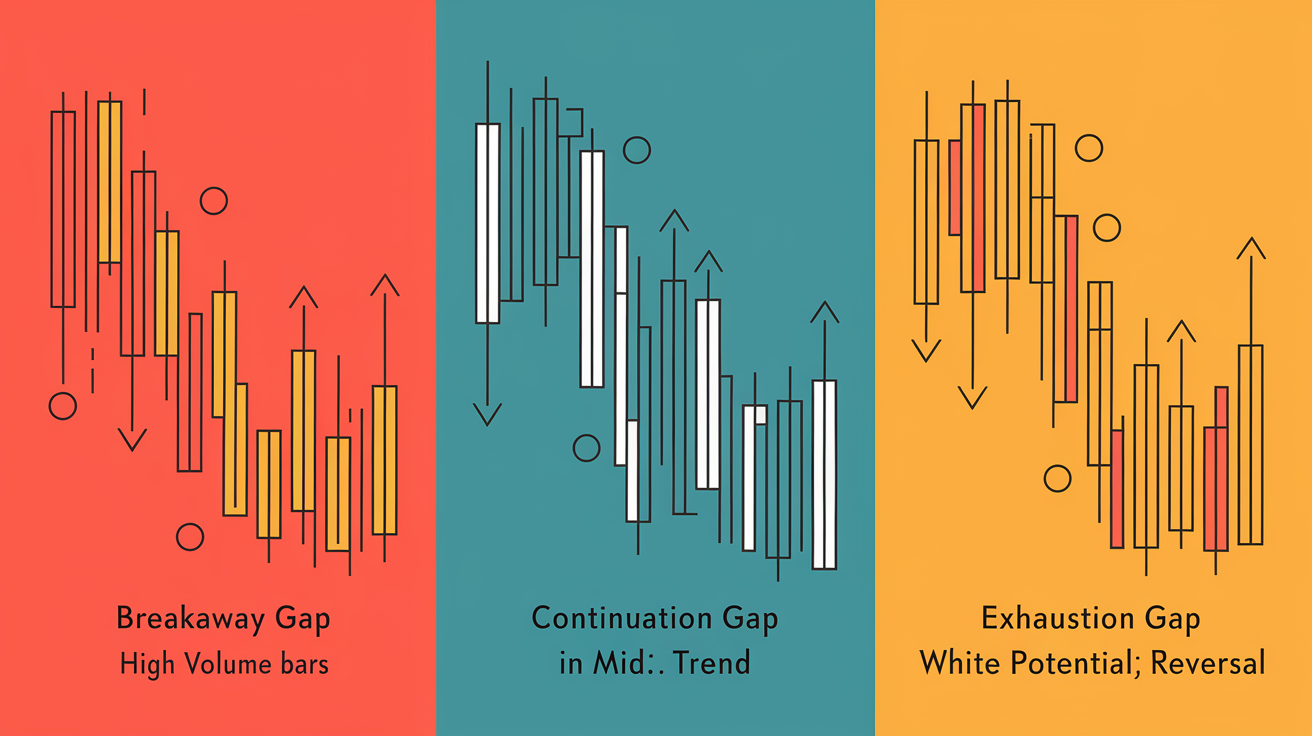
Breakaway gaps mark the start of a new trend and typically appear when a stock breaks out of a consolidation range or chart pattern such as a triangle or rectangle. These gaps occur on high volume and often follow significant news like strong earnings or a major product launch. A breakaway gap that pushes a stock from 50 to 55 at the open, accompanied by volume 2.5 times the daily average, signals that buyers are stepping in aggressively and a sustained uptrend may be beginning. Breakaway gaps are less likely to fill quickly because they represent a fundamental shift in investor sentiment or company outlook.
Continuation gaps, also called runaway or measuring gaps, appear in the middle of an established trend and reinforce the existing momentum. If a stock’s been climbing steadily for two weeks and suddenly gaps up 3 percent on moderately elevated volume, that gap confirms ongoing strength. Continuation gaps occur when positive news arrives during an uptrend, attracting additional buyers who push the price higher without hesitation. These gaps often remain unfilled for extended periods as long as the trend persists. Traders view continuation gaps as validation that the current move has further to run.
Exhaustion gaps emerge near the end of a trend after a prolonged rally or decline. They reflect a final surge of buying or selling that exhausts remaining participants. An exhaustion gap might appear after a stock rallied 40 percent over several weeks, gapping up another 5 percent on falling volume. Within days, the stock stalls and reverses because the gap represented the last wave of enthusiasm rather than the start of a new leg. Identifying exhaustion gaps requires attention to volume patterns and trend maturity. When volume declines as the gap forms, caution is warranted.
Gap type summary:
- Breakaway gap: Signals new trend initiation, high volume, often follows major catalyst, unlikely to fill soon.
- Continuation gap: Occurs mid trend, moderate volume, confirms momentum, typically remains open during trend.
- Exhaustion gap: Appears at trend end, declining volume, warns of reversal, may fill quickly as trend exhausts.
When markets open higher, it’s usually because overnight news, strong pre-market buying, or an opening auction imbalance pushes the opening price above yesterday’s close.
You saw the core mechanics: what a gap is, how after-hours earnings and headlines move prices, how global markets and futures set the tone, and how order imbalances convert sentiment into a higher open. Watch pre-market volume and the opening auction for confirmation.
If you trade these moves, set entry, confirmation, and stop rules. Knowing what causes stock gaps up at market open helps you act with more confidence and catch opportunities.
FAQ
Q: Why do stocks gap up in premarket? Why does the market open gap up?
A: Stocks gap up in premarket or at the open when after-hours earnings, news, or global moves create buy imbalances; low pre-market liquidity and the opening auction let the price reset higher.
Q: What is the 10am rule in stocks?
A: The 10am rule in stocks says the market’s direction by 10am often predicts the rest of the day; trade with that early trend but watch for reversals or new catalysts that change momentum.
Q: What is the 3-5-7 rule in trading?
A: The 3-5-7 rule in trading is a simple confirmation approach using 3-, 5-, and 7-period signals or timeframes to validate entries and exits; require agreement across them and manage risk closely.