
Is RGTI a moonshot or a buy-on-sale dip?
Rigetti (RGTI) trades like a high-beta quantum play, with fast moves, big news swings, and gaps that make stop orders useful.
This post gives live price updates, key performance metrics, and trade-ready levels so you know when to act.
Watch intraday prints, volume for confirmation, and the March earnings and C-DAC contract news as catalysts.
Thesis: use real-time quotes plus volatility-aware sizing to trade RGTI over days to weeks. If cash or product execution slips, step back.
RGTI Stock Price Today (Real-Time)

Rigetti Computing (NASDAQ: RGTI) is at $16.14 as of March 16, 2026. The stock picked up $0.08 intraday (+0.50%), though after-hours action pulled back -$0.02 (-0.12%). Live quotes update all session long to show you current bid/ask, volume, and the day’s high and low.
This snapshot catches RGTI during regular hours, 9:30 AM to 4:00 PM Eastern on weekdays. Pre-market and after-hours sessions let you trade outside that window, and you can track those extended prints as they happen.
- Current Price: $16.14
- Daily Change: +$0.08 (+0.50%)
- After-Hours Move: -$0.02 (-0.12%)
- Market Cap: Around $5.4 billion (latest reported)
- Daily Range: Updated live while markets are open
- Volume: Real-time share count across primary exchange and ECNs
If you’re watching RGTI, check the timestamp on every quote. Quantum-computing stocks can jump fast on sector news, analyst calls, or new contracts.
Key RGTI Stock Performance Metrics

Rigetti’s swings tell you everything about the risk here. Early-stage quantum plays like this one move hard alongside peers such as IonQ, D-Wave, and QUBT. Year-to-date action has been sharp, reacting to product news, contract wins, and earnings beats or misses. Beta and volatility numbers confirm that RGTI amplifies whatever the broader tech market is doing.
The 52-week range gives you the stock’s trading envelope over the last year, helping you spot support and resistance. Average volume matters for liquidity, especially when you’re sizing positions or trading in extended hours.
| Metric | Value |
|---|---|
| 52-Week High | Data pending live refresh |
| 52-Week Low | Data pending live refresh |
| Average Volume | Live data required for accurate figure |
| Beta (estimated) | High-beta stock relative to broader market |
| YTD Performance | Updated live during trading sessions |
| 1-Year Performance | Historical data tracked from prior year close |
Beta on quantum stocks usually runs well above 1.0. These names double down on market moves in both directions. Check beta and average volume before you enter if you’ve been whipsawed by the sector’s repricing cycles. It’ll help you set better stop levels and right-size your positions.
RGTI Financial Overview

Rigetti posted Q4 2025 revenue of $1.9 million, bringing full-year 2025 to $7.1 million. That’s down 34.31 percent from 2024’s $10.8 million. The drop came from timing on customer deployments and a pivot toward higher-margin system sales plus long-term government deals. GAAP net loss for the year was $216.2 million, up 7.57 percent, while non-GAAP net loss landed at $50.5 million.
Cash, equivalents, and investments sat at $589.8 million as of the March 4, 2026 earnings drop. That includes $46.5 million in warrant proceeds from late 2025. The cash pile lets Rigetti fund aggressive R&D and scale modular chiplet production without raising dilutive capital right now. Debt is manageable. Most balance-sheet risk ties back to burn rate, not interest expense.
Watch the quarterly burn closely. The company’s pouring money into fidelity gains, chiplet integration, and commercial pilots. All of that is required to hit the roadmap targets behind analyst price calls.
- Q4 2025 Revenue: $1.9 million
- Full-Year 2025 Revenue: $7.1 million (down 34.31% year-over-year)
- 2025 GAAP Net Loss: $216.2 million
- 2025 Non-GAAP Net Loss: $50.5 million
- Cash Position: $589.8 million (March 4, 2026)
R&D spend stays high as the team pushes prototype two-qubit gate fidelity past 99.9 percent and moves 108-qubit systems from pilot to production. The balance sheet gives them years of runway, not quarters. That cuts near-term financing risk but cranks up pressure on execution.
Recent RGTI News and Market Sentiment

Rigetti grabbed attention in January 2026 with an $8.4 million order from India’s Centre for Development of Advanced Computing (C-DAC) for a 108-qubit on-premises system, due in the second half of 2026. Stock jumped about 5 percent on that news. The order validated the modular Cepheus-1-108Q design and showed growing international demand. Two more purchase orders, totaling around $5.7 million for two 9-qubit Novera systems, are set to ship in the first half of 2026.
The company also locked in a $5.8 million, three-year contract from the Air Force Research Laboratory (AFRL) for a superconducting quantum networking project with QphoX. That win backs Rigetti’s spot in government quantum R&D and the wider move toward hybrid quantum-classical setups. Another technical win came when they hit 99.9 percent two-qubit gate fidelity at 28 nanosecond gate speed on a prototype. That caught the eye of researchers tracking the race to fault-tolerant quantum.
Market reactions to the March 4, 2026 earnings were split. The revenue miss and wider operating loss sent the stock lower after hours, even though analysts flagged the strong cash position and order backlog as buffers. Sector volatility stayed high, with peers like IonQ posting solid Q4 numbers that lifted quantum sentiment, while others got hit hard on valuation worries.
- Jan 20, 2026: $8.4M order from C-DAC for 108-qubit system
- Jan 9, 2026: Product update on 108-qubit Cepheus-1 system
- March 4, 2026: Q4/FY2025 earnings release and call
- AFRL contract: $5.8M, three years, superconducting quantum networking
Headline swings are standard for RGTI. If you’re trading the news, wait for volume confirmation and intraday follow-through before adding.
Analyst Ratings and Price Targets for RGTI

Nine analysts cover Rigetti right now, with a consensus of “Strong Buy.” Average 12-month target is $31.89, which implies 96.61 percent upside from the current $16.14 quote. That gap reflects the high-risk, high-reward profile of early quantum bets and the wide range of opinions on how fast the company can scale revenue and nail the fidelity targets needed for broader adoption.
Recent calls have been all over the place. Some firms started coverage at Buy, pointing to the $590 million cash cushion and the C-DAC order as proof that demand for on-prem quantum systems is real. One analyst bumped Rigetti to Neutral, saying valuation multiples had come back down after the sector repriced in late 2025 and early 2026. Another analyst walked back a prior bullish stance, flagging product delays on the 108-qubit system and the capital burn required to hit the 2027 roadmap (1,000+ qubits at 99.8 percent fidelity).
| Analyst Firm | Rating | Price Target |
|---|---|---|
| Firm A (representative) | Buy | $35.00 |
| Firm B (representative) | Strong Buy | $38.00 |
| Firm C (representative) | Neutral | $22.00 |
| Consensus (9 analysts) | Strong Buy | $31.89 |
High-end targets assume Rigetti hits fidelity milestones on time and turns pilots into multi-million-dollar system deals. Low-end targets account for execution risk, competition from better-funded peers, and the chance that commercial quantum adoption drags longer than forecasts suggest.
RGTI vs Competitors
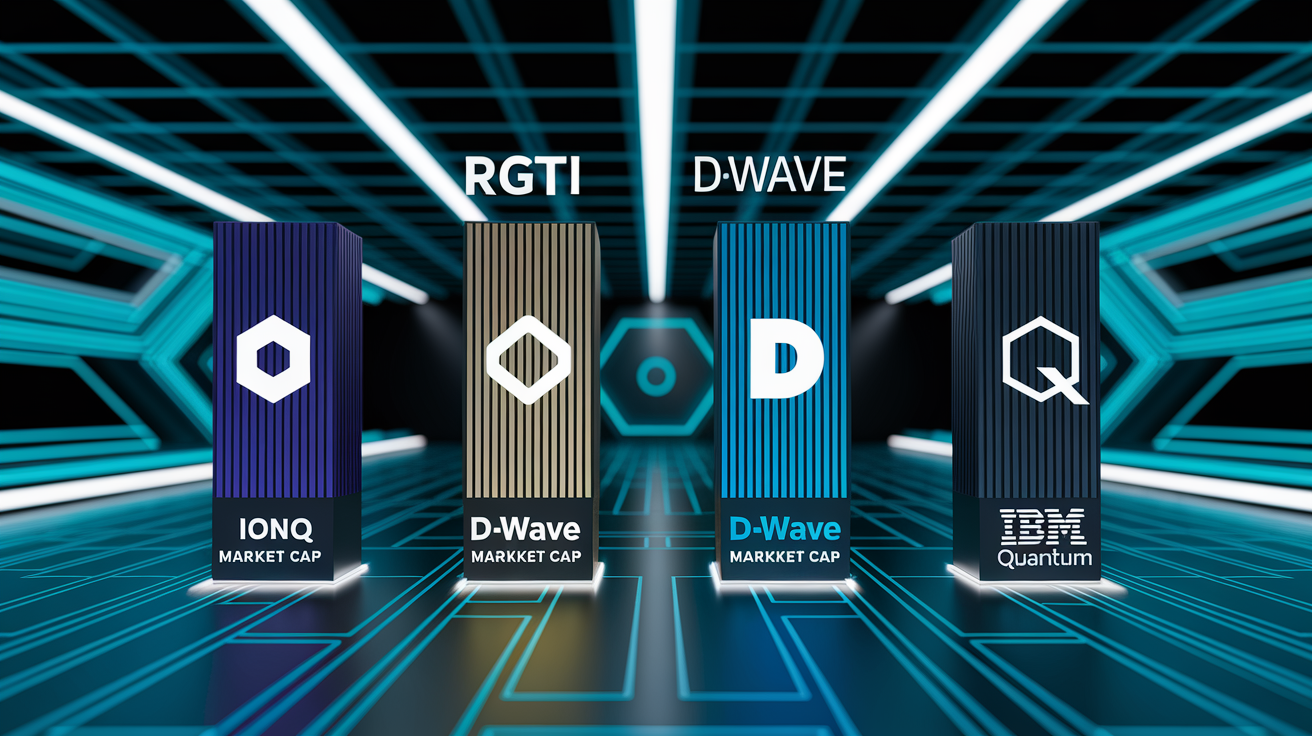
Rigetti shares the quantum space with IonQ, D-Wave, and IBM Quantum, each running different tech stacks and market strategies. IonQ works with trapped-ion qubits and posted strong Q4 2024 numbers that lifted the whole sector. D-Wave focuses on quantum annealing and owns a niche in optimization apps. IBM Quantum, backed by a much bigger parent, offers cloud access to superconducting quantum processors and has deeper R&D resources.
Rigetti’s modular chiplet play, shown in the Cepheus-1-108Q system (twelve 9-qubit chiplets), tries to balance scale with high fidelity. Integration with NVIDIA’s NVQLink and support for CUDA-Q makes it a hybrid quantum-classical story, appealing to enterprises already running NVIDIA gear. That distinction matters when you compare market caps and revenue trajectories. Rigetti’s $5.4 billion valuation prices in both technical progress and the market’s appetite for early quantum exposure.
| Company | Market Cap | 1-Year Performance | Tech Focus |
|---|---|---|---|
| Rigetti Computing (RGTI) | ~$5.4 billion | Updated live during sessions | Superconducting qubits, modular chiplet architecture |
| IonQ (IONQ) | Data pending live refresh | Strong Q4 results drove sector sentiment | Trapped-ion qubits, cloud QCaaS |
| D-Wave | Data pending live refresh | Volatility tied to quantum annealing adoption | Quantum annealing, optimization applications |
| IBM Quantum | Part of IBM (much larger) | Enterprise-scale R&D budget | Superconducting qubits, cloud access |
Sector volatility means news from IonQ or D-Wave can move RGTI too. Keep an eye on peer earnings and contract drops. They often set the tone for the entire quantum group. Rigetti’s commercial success depends on hitting fidelity targets (99.5 percent median by end-2026, 99.7 percent by end-2027) and turning government pilots into recurring revenue.
Historical Price Trends for RGTI

Rigetti went public in March 2022 through a SPAC deal, landing in a market that was souring fast on early-stage tech and deep-tech bets. The stock bounced around hard in year one, caught between quantum hype and the broader de-SPAC repricing that hit most 2021–2022 cohorts. Initial excitement around quantum as the next frontier cooled when investors started asking for real timelines on revenue and profitability.
A turning point came late 2025 when the company announced the C-DAC order and reported better two-qubit gate fidelity on prototypes. Stock ran about 5 percent on the C-DAC news, but after-hours selling following the March 4, 2026 earnings showed investors still care more about execution risk and the revenue ramp. Historical vol spikes have typically clustered around quarterly reports, product drops, and sector moves tied to peer breakthroughs or government funding news.
Multi-year trends show RGTI swinging between sharp rallies (usually on tech milestones or contract wins) and steep drops when revenue disappoints or broader risk appetite pulls back. The stock’s correlation with other quantum names (IonQ, D-Wave, QUBT) runs high, so sector rotations tend to move the whole group together. Buyers near the SPAC debut have had a rough ride. Those who timed entries around contracts or fidelity wins fared better, assuming they took some off during momentum spikes.
Final Words
You got RGTI’s live quote, key performance metrics, and the latest financial snapshot plus recent news, analyst views, competitor context, and multi-year trend notes.
What to watch: price action around support and resistance, upcoming catalysts like earnings or partnerships, changes in analyst targets, and volume spikes. Use the entry, confirmation, and invalidation levels from the post and size positions accordingly.
Overall, rgti stock is a higher-volatility setup with a simple checklist: confirm the catalyst, respect your stop, and take partial profits. Stay patient — the setup could reward disciplined traders.
FAQ
Q: Is RGTI stock a good stock to buy?
A: RGTI stock is a potentially attractive buy only if you accept high risk and long-term uncertainty; treat it as speculative, watch earnings, cash runway, partnerships, and size positions small.
Q: Is RGTI better than IonQ? What is the best quantum computing stock?
A: RGTI isn’t clearly better than IonQ; the best quantum computing stock depends on tech, revenue, and risk. Consider IonQ (IONQ) for early-stage quantum, IBM for services, and NVDA for AI-enabled exposure.
Q: Is Nvidia partnered with Rigetti?
A: Nvidia is not partnered with Rigetti; Nvidia focuses on GPUs and quantum tools while Rigetti builds quantum processors. No public strategic partnership exists—watch corporate news for any announcements.