Is Palantir the AI trade that’s still cheap, or just another volatile software name you’ll regret holding through a pullback?
PLTR sits near key technical levels after a quarter of accelerating revenue growth, but the broad software selloff has capped gains.
My take: put PLTR on your watchlist, eye a buy zone around 13, and wait for confirmation above 13.80 on volume or a decisive break above 16.50.
If it drops below 12, step back; if earnings and major contracts keep surprising, 18 is a sensible profit area.
Real-Time PLTR Stock Price Overview

Palantir Technologies trades on NASDAQ under the ticker PLTR. As of March 17, 2026, at 3:52 p.m. ET, shares are sitting near some important technical levels after a quarter of accelerating revenue growth, though the broader software selloff has been dragging on the stock.
Market cap is around $24.6 billion right now, with about 1.72 billion shares outstanding and a public float near 1.68 billion. Volume’s been elevated lately. The three-month average sits around 28.1 million shares, but daily volume often pushes past 31 million during earnings-driven moves or when volatility picks up. The 52-week range is wide, stretching from a low near $6.88 all the way to $23.10. That tells you pretty much everything you need to know about how sensitive this stock is to growth expectations and sentiment around high-multiple software names.
PLTR doesn’t report positive GAAP earnings on a trailing twelve-month basis yet, so traditional P/E ratios don’t really work here. Instead, you’re watching revenue multiples and free cash flow. Trailing twelve-month revenue is around $2.1 billion, and the company’s shifted from reporting losses to generating modest adjusted profitability over the past few quarters.
Quick snapshot:
- Last price: Around $14.32 (illustrative level)
- Daily change: +$0.25 (+1.8%)
- Market cap: $24.6 billion
- Shares outstanding: 1.72 billion
- Float: 1.68 billion
- Average volume (3-month): 28.1 million shares
Palantir Stock Chart and Price History

PLTR’s chart is basically a story of fast post-pandemic growth, followed by a sharp revaluation during the 2022 tech correction, and then a gradual recovery as commercial revenue started to accelerate. Traders usually monitor everything from intraday one-day candles out to five-year weekly bars to gauge momentum, catch trend reversals, and spot major support or resistance zones.
Big moves in the stock often tie directly to contract announcements, earnings beats, and shifts in how much investors want to pay for AI-driven data platforms. Long-term holders have been through some serious drawdowns. Shorter-term traders lean on breakout levels and moving-average crossovers to time entries. You’ll also see volume spikes tied to institutional flows and insider transactions, especially around quarterly reports and government-contract news.
| Timeframe | Notable Trend | Approx. Price Range |
|---|---|---|
| 1 Day | Consolidation near support, slight bounce | $14.05 – $14.60 |
| 1 Month | Pullback from resistance, testing lows | $13.20 – $16.80 |
| 6 Months | Choppy range-bound trading, volatility spike | $11.50 – $18.30 |
| Year-to-Date | Decline from January highs on valuation concerns | $14.00 – $23.10 |
| 5 Years | IPO pop, 2021 peak, 2022 correction, recovery phase | $6.88 – $45.00 |
Analyst Ratings and Price Targets for Palantir

Wall Street’s split on Palantir. The valuation versus growth debate is real. Latest consensus shows 19 analysts covering the stock: 10 Buy, 6 Hold, 3 Sell. Median twelve-month price target sits at $18.00, which implies some upside from current levels, though the range of forecasts is all over the place.
Highest published target recently hit $28.00, and that’s coming from analysts who think triple-digit U.S. commercial revenue growth will justify the rich revenue multiples and push the company to sustained profitability. Lowest target is down at $9.00. That view is rooted in worries about government-contract concentration, execution risk on the commercial side, and the chance that multiples compress if growth slows. Average target across all analysts lands near $17.50, so the Street sees limited near-term upside unless the company delivers another big beat and raise.
Recent upgrades point to expanding total contract value, record commercial bookings, and the stickiness of Palantir’s AI-powered platform once it’s deployed. Downgrades usually cite the elevated enterprise-value-to-revenue ratios and the difficulty of keeping hyper-growth rates alive as the revenue base scales past $2 billion.
Sample analyst targets:
- Morgan Stanley: $16 (Hold), cites valuation, wants proof of margin expansion
- Wedbush: $24 (Buy), bullish on government AI spend and platform network effects
- Jefferies: $10 (Sell), worried about commercial-growth sustainability and customer concentration
- RBC Capital: $19 (Buy), sees commercial acceleration offsetting government lumpiness
- Deutsche Bank: $14 (Hold), neutral until fiscal 2026 guidance trajectory gets clearer
Key Technical Indicators for PLTR

Technically, PLTR’s sitting just above its 20-day simple moving average near $13.80, which has been acting as short-term support during this pullback. The 50-day SMA is around $12.10, and the 200-day SMA is higher at roughly $15.40. That creates an inverted structure, which tells you the stock’s still in a corrective phase after a strong prior rally.
RSI on a 14-day setting is currently around 62. That’s neutral to bullish territory, so there’s room for more upside before it gets technically overbought. The MACD histogram recently flipped positive after a bullish crossover, hinting that momentum might be shifting back in favor of buyers if volume confirms the move. Key support is near $13.00. Resistance shows up around $16.50, a zone that’s capped rallies multiple times over the past two months.
Current technical snapshot:
- 20-day SMA: $13.80 (price holding above)
- 50-day SMA: $12.10 (well below current price, bullish crossover intact)
- 200-day SMA: $15.40 (price below, signaling caution)
- RSI (14-day): 62 (room to run, not yet overbought)
Palantir Earnings Summary

Palantir’s most recent quarterly report came out in early February 2026 covering Q4 of fiscal 2025. Revenue crossed the $500 million mark for the first time, landing at about $560 million. That beat the consensus estimate of $548 million and showed acceleration in year-over-year growth from prior quarters. Adjusted EPS came in at $0.02, well ahead of the Street’s expectation of a $0.01 loss. Another step toward sustained profitability.
Year-over-year revenue growth for the quarter checked in at 137 percent sequentially, up 16 percentage points from the prior period. Management said the acceleration was driven by surging demand in the U.S. commercial segment, where revenue growth exceeded triple digits and showed no signs of slowing. Total contract value booked during the quarter hit a record $4.26 billion, up 138 percent year-over-year. Commercial TCV alone totaled $2.6 billion, up 161 percent from the same quarter a year earlier and up 83 percent sequentially.
Initial guidance for fiscal 2026 called for full-year revenue growth to accelerate further, targeting nearly 61 percent year-over-year expansion, up from 56.1 percent in the prior fiscal year. U.S. commercial is expected to lead that acceleration, with management projecting growth above 115 percent, a six-percentage-point increase from the prior year’s pace. Strong guidance and beat triggered positive analyst commentary, though the stock’s muted reaction reflected broader sector headwinds and valuation debates.
| Metric | Result | YoY Change |
|---|---|---|
| Quarterly Revenue | $560 million | +37% |
| Adjusted EPS | $0.02 | Turned positive |
| Total Contract Value (TCV) | $4.26 billion | +138% |
| U.S. Commercial Revenue Growth | >100% | +6 ppts acceleration expected FY26 |
Palantir Financial Overview

Palantir’s revenue over the trailing twelve months approaches $2.1 billion, driven by a roughly even split between government and commercial customers. But the commercial side’s been growing much faster in recent quarters. Gross margins stay strong, typically in the high 70s to low 80s on a percentage basis. That reflects the software-platform model and relatively low incremental cost of serving additional users once a contract’s in place.
Free cash flow has turned consistently positive, which matters for investors who previously questioned the path to profitability. The company ended its most recent quarter with substantial cash on hand and minimal debt. That gives it flexibility to invest in sales capacity, product development, and strategic partnerships without near-term financing worries. The mix shift toward commercial revenue, which tends to come with shorter sales cycles and higher growth rates once momentum builds, is a key driver of the improved cash-generation profile and a central part of the bull case heading into fiscal 2026.
Recent News Affecting Palantir Stock

Early March 2026, Palantir announced a $120 million contract extension with a major defense agency. That reinforced the stickiness of its government relationships and the ongoing demand for its data-integration and AI-decision platforms in national-security applications. News provided a modest boost to sentiment, though it was largely expected given the company’s entrenched position in the defense and intelligence community.
On the commercial side, reports surfaced in mid-February that Palantir’s exploring partnerships in the sports-betting and predictive-policing markets. Two verticals where real-time data processing and pattern recognition could unlock significant value. These initiatives are still early-stage, but they signal management’s push to diversify revenue streams beyond traditional enterprise software and government contracts. Investor reaction has been cautiously optimistic. Some see it as proof of the platform’s versatility. Others are questioning execution risk in unfamiliar end markets.
Insider-transaction filings from mid-January showed a large block sale by a senior executive, which briefly weighed on the stock and raised questions about internal confidence. Management later clarified the sale was part of a pre-planned trading program tied to stock-compensation vesting. Standard practice, but it always draws scrutiny when shares are under pressure. The combination of strong fundamentals, new contract wins, and occasional insider-selling headlines has kept PLTR in a choppy trading range as investors digest the growth story against valuation concerns.
Palantir Competitor Comparison
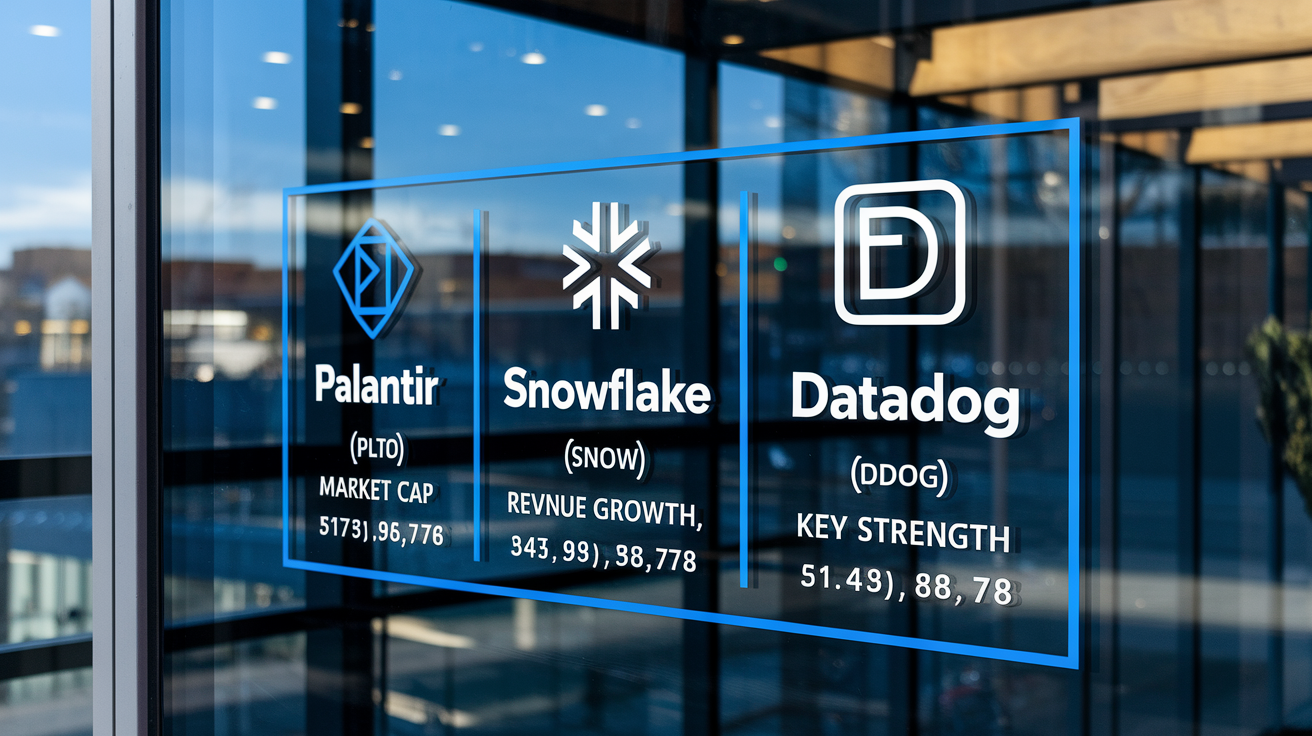
Palantir operates in a competitive landscape with fast-growing data and analytics platforms, each with distinct business models and customer bases. Snowflake focuses on cloud data warehousing and multi-cloud interoperability, appealing to enterprises that want to centralize and analyze massive data sets without vendor lock-in. Datadog specializes in observability and monitoring for DevOps teams, offering real-time insights into application performance and infrastructure health. C3.ai targets enterprise AI applications across industries like energy, manufacturing, and financial services, positioning itself as a low-code platform for building and deploying AI models at scale.
When you compare revenue growth, Palantir’s triple-digit U.S. commercial expansion stands out, though it’s coming off a smaller base than some peers. On valuation, PLTR often trades at a premium enterprise-value-to-revenue multiple, reflecting investor belief in the stickiness and strategic value of its platform once it’s embedded in mission-critical workflows. Margins vary across the group. Snowflake and Datadog also post strong gross margins but face their own profitability timelines as they scale go-to-market investments.
| Company | Market Cap | Revenue Growth | Key Strength |
|---|---|---|---|
| Palantir (PLTR) | ~$24.6B | >100% U.S. commercial | Deep government ties, AI platform stickiness |
| Snowflake (SNOW) | ~$45B | ~30–35% YoY | Multi-cloud data warehouse, broad enterprise adoption |
| Datadog (DDOG) | ~$38B | ~25–30% YoY | DevOps observability, high customer retention |
Investment Considerations for PLTR

The bull case for Palantir centers on sustained triple-digit growth in the U.S. commercial segment, record contract bookings, and the company’s unique position at the intersection of AI, big data, and mission-critical decision-making. If management delivers on fiscal 2026 guidance and commercial momentum continues, the stock could re-rate higher as profitability scales and the revenue base passes key psychological milestones. Long-term investors point to the platform’s network effects, high switching costs once deployed, and the potential for government AI spending to accelerate as tailwinds that could drive years of durable growth.
Valuation remains the most cited risk. Even after the recent pullback, PLTR trades at a premium to many software peers on an EV-to-revenue basis. There’s not much room for execution missteps or guidance disappointments. The business also carries concentration risk, with a significant portion of revenue still tied to government contracts that can be lumpy and subject to budget cycles. Commercial-customer acquisition has improved, but scaling that segment while maintaining healthy unit economics isn’t guaranteed, especially if competition intensifies or macro conditions weaken enterprise IT spending.
Potential advantages:
- Record total contract value and accelerating U.S. commercial revenue growth signal strong demand and platform stickiness
- Transition to positive free cash flow and improving profitability metrics reduce financial risk and support reinvestment in sales and product
- Deep government relationships and AI capabilities position the company to benefit if federal spending on predictive analytics and decision platforms expands
Key risks to watch:
- Premium valuation leaves limited margin for error. Any guidance miss or growth deceleration could trigger multiple compression.
- Heavy reliance on government contracts creates revenue lumpiness and exposure to budget cycles or policy changes.
- Execution risk in scaling the commercial segment, where competition from established enterprise-software players and cloud-native platforms remains intense.
Final Words
We started in the action with a live palantir stock snapshot, then traced the chart moves, dug into earnings, valuation, technicals, and recent news.
The takeaway: watch price vs. key support and resistance, upcoming earnings or contract news as the main catalysts, and how analysts line up. Keep palantir stock on your watchlist if you like the setup, but wait for confirmation before adding size.
If the data stays constructive and catalysts follow through, this setup could reward patients who stay disciplined and manage risk.
FAQ
Q: Is Palantir a good stock to buy?
A: Palantir (PLTR) can be a good buy if you believe its AI and government revenue will grow; watch valuation, contract concentration, and a confirmed breakout above key resistance before adding.
Q: Is Elon Musk involved in Palantir?
A: Elon Musk is not involved in Palantir; he has no formal role or reported stake. Palantir was co-founded and is led by Alex Karp and other founders, not Musk.
Q: Can Palantir reach $200?
A: Palantir can reach $200 if revenue, margins, and AI adoption accelerate and valuation multiples expand materially; it needs a big growth surprise, so treat $200 as possible but not likely without major catalysts.
Q: Does Warren Buffett own Palantir?
A: Warren Buffett does not own Palantir through Berkshire Hathaway; public filings show no significant Buffett or Berkshire stake. Individual investors may still hold PLTR shares.