Think a buyback announcement is a free shot to the upside? Think again.
Most of the time, announcing a stock buyback lifts the share price right away.
That happens because it signals management thinks shares are undervalued and it shrinks the share count, automatically boosting EPS (earnings per share) and pulling in momentum buyers.
But not all announcements are equal.
Size, funding, timing, and insider behavior change the story.
Watch buyback size vs market cap, whether cash or debt pays for it, and if insiders are selling.
If those red flags appear the initial pop often fades.
Immediate Stock Price Effects From Buyback Announcements
When a company announces a stock repurchase program, the market usually responds with an immediate price bump on the announcement day or within a few trading sessions. This upward move stems from two main forces: a signal that management thinks shares are undervalued, and the expectation of reduced supply as shares leave the market. Investors read the announcement as a confident vote by insiders who have the clearest view of the company’s prospects. That confidence alone can pull in buyers before a single share is actually retired.
The mechanics behind earnings per share accretion explain a lot of the positive reception. Net income stays the same while the number of outstanding shares falls, so EPS rises automatically. This can happen much faster than operational improvements would normally allow. The market rewards higher EPS growth with a higher valuation multiple, creating a feedback loop where the announcement becomes a catalyst for price appreciation. Research shows that buybacks can stabilize prices in the short term, providing a floor under shares during volatile periods and reinforcing the perception of management support.
Several distinct drivers combine to produce announcement day abnormal returns:
Confidence signal. Management is willing to deploy cash to buy its own stock, implying shares are trading below intrinsic value.
Supply reduction. Fewer shares outstanding means each remaining share claims a larger slice of earnings and assets.
EPS accretion. The immediate mathematical boost to per share metrics attracts momentum and growth oriented buyers.
Institutional rebalancing. Large announcements prompt funds to adjust position sizes and trigger algorithmic buying programs.
Media and analyst attention. Coverage of sizable repurchase programs draws retail and institutional interest, amplifying demand.
Over the long sweep of history, corporate buybacks have been a dominant source of equity demand. Since 2000, net corporate repurchases have totaled about $5.5 trillion, effectively accounting for 100 percent of the equity market’s net asset purchases during that span. Short term data underscores the tight linkage: a correlation of roughly 0.85 has been observed between four week percentage changes in buyback activity and four week changes in the S&P 500. When companies step up buybacks, markets rise. When they pull back, the absence of that artificial demand can worsen sell-offs. One April saw buybacks decline nearly 20 percent and markets felt it.
Financial Statement Changes That Influence Buyback Announcement Impact
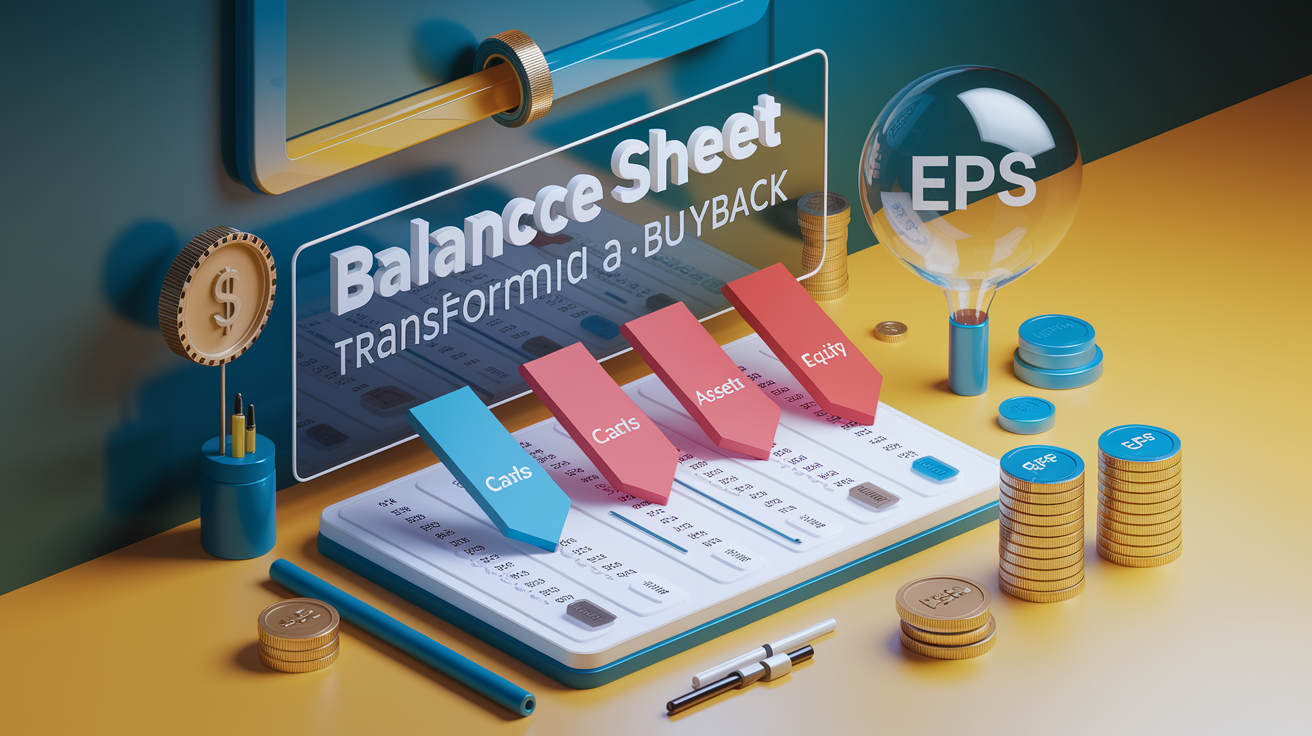
Repurchasing shares rewrites the balance sheet in ways that matter to investors long before the first block of stock is retired. Cash holdings decline by the total buyback amount, reducing total assets. At the same time, shareholders’ equity shrinks because the company is returning capital to owners by buying out a portion of the ownership base. These twin reductions set the stage for the optical improvements that often drive positive market reactions to repurchase announcements.
Earnings per share climbs because the denominator in the EPS calculation falls while the numerator stays constant. Return on equity and return on assets both tend to improve. ROE rises when equity drops faster than earnings, and ROA rises when assets shrink. These ratio enhancements can make a company appear more efficient and more profitable on a per unit basis, even though the underlying business operations haven’t changed. The cash outflow from the buyback appears under financial activities in the statement of cash flows. Retained earnings on the balance sheet decline by the repurchase amount, formally recording the capital return.
Investors react to these accounting shifts because they translate into better looking headlines. Higher EPS growth rates, stronger return metrics, and a leaner balance sheet. Analysts update their models to reflect the new share count, often raising price targets in response to the accretive math. The announcement itself can trigger upgrades and increased buy ratings, which in turn attract fresh capital and push the stock higher before a single share is actually bought back. This perception driven dynamic explains why even the promise of a buyback, rather than its execution, can move markets.
Understanding Buyback Announcement Motives and Their Market Impact
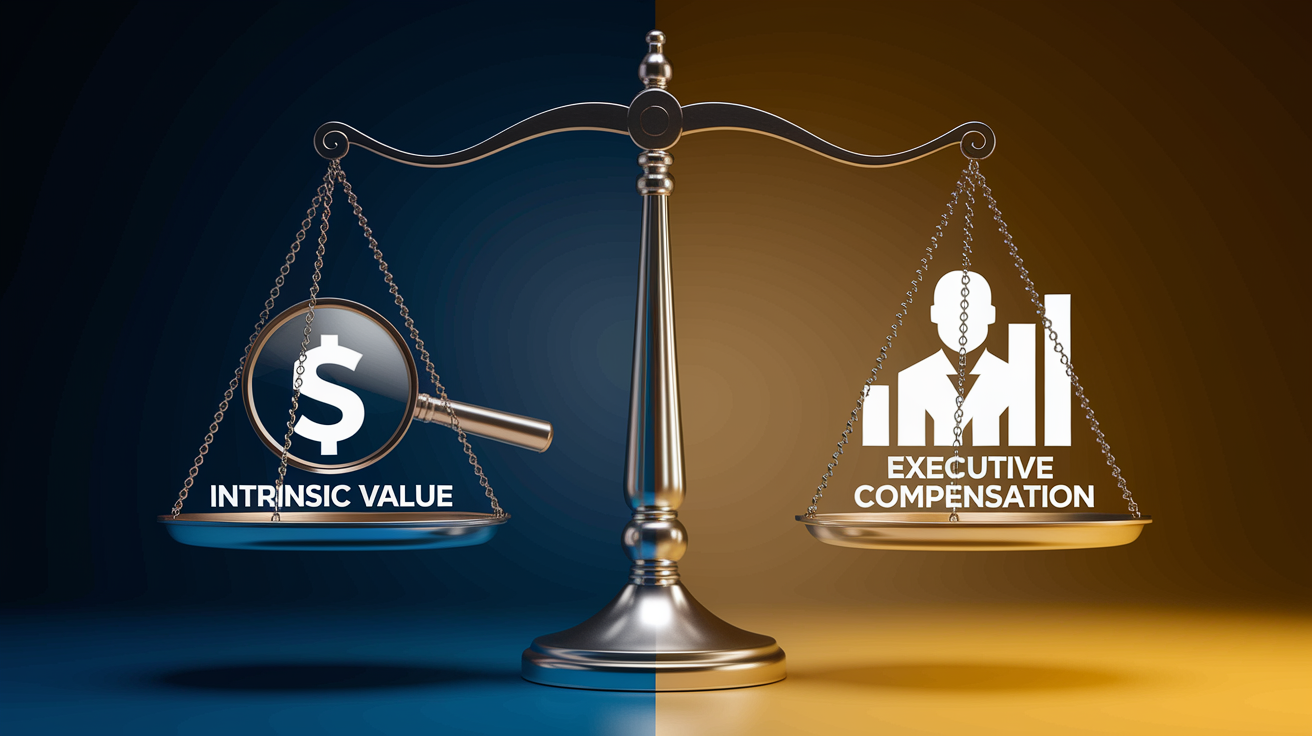
Companies cite a range of reasons when announcing repurchase programs, and the stated motive shapes how investors interpret the news. The most investor friendly explanation is that management believes shares are trading below intrinsic value and that buying back stock is the highest return use of excess cash. When a business generates more free cash flow than it can profitably reinvest in operations or acquisitions, returning that capital through buybacks can be a disciplined way to avoid hoarding unproductive cash or making ill advised expansion moves. Announcements framed as opportunistic capital return, especially when paired with healthy revenue growth and solid margins, tend to be received as genuine signals of strength.
Not all buyback motives align neatly with shareholder interests. A significant driver is the desire to boost stock based executive compensation, which is typically tied to share price and earnings per share targets. By mechanically lifting EPS and supporting the stock price, buybacks can trigger bonus vesting and option gains for management even when operating performance stagnates. One survey of chief financial officers found that 93 percent cited “influence on stock price” and “outside pressure” as reasons for manipulating earnings figures, highlighting the incentive to use repurchases as a tool for managing quarterly results. Companies also sometimes announce buybacks to offset dilution from employee stock awards, a practice known as sterilization that replaces one block of shares with another rather than truly reducing supply.
Governance and agency conflicts come into play when insiders prioritize short term stock price boosts over long term value creation. Buybacks can be timed around periods when executives plan to sell their own holdings or exercise options, allowing them to offload shares into a market buoyed by the repurchase announcement. When companies repurchase at high valuations, buying near all time highs rather than opportunistically during sell-offs, they effectively transfer wealth from long term shareholders to those selling at the elevated price. Debt funded buybacks amplify this concern, as they saddle the balance sheet with interest obligations in exchange for a fleeting EPS pop.
How the market reacts to a buyback announcement depends heavily on which motive investors believe is at work. Announcements accompanied by rising revenue, expanding margins, and a track record of accretive repurchases at reasonable valuations tend to lift share prices and sustain those gains. Buybacks that coincide with flat or declining sales, heavy insider selling, or high leverage often see muted reactions or even negative price moves as the market reads the program as financial engineering rather than a vote of confidence.
Evaluating Buyback Size, Timing, and Funding for Market Impact Assessment

The absolute dollar amount of a buyback authorization provides critical context for gauging its potential impact. Large programs signal major capital deployment and typically move share prices more than smaller, incremental authorizations. Recent expansions that added $100 billion and $70 billion, together representing roughly 12 percent of annual buyback totals across U.S. markets, are good examples. You should compare the buyback size to both the company’s market capitalization and its cash position. A repurchase equal to 5 or 10 percent of market cap is material, while a program representing more than 50 percent of annual profits suggests management is prioritizing share retirements over reinvestment in the business.
Timing plays an outsized role in shaping market reactions. Companies often cluster announcements around earnings releases, product launches, or political cycles such as re-election years, when broader market sentiment tends to be more favorable and media attention is high. Buybacks timed just before major positive news allow insiders to purchase shares at lower prices and then benefit from the post announcement rally. Suspending buybacks during downturns, when shares are cheapest and repurchases would be most accretive, reveals that many programs are designed to support prices rather than opportunistically build value. Calendar driven strategies can amplify short term price moves but also raise red flags about whether the program serves shareholders or management compensation targets.
The source of funding determines whether a buyback strengthens or weakens the company’s financial position. Repurchases funded from ample free cash flow leave the balance sheet intact and demonstrate that the business generates more cash than it needs for operations and growth. Debt funded buybacks increase leverage and fixed interest obligations, exposing the company to greater risk during economic downturns. When a firm borrows to repurchase shares at elevated valuations, it effectively trades equity cushion for debt service, a move that can backfire if earnings soften or credit markets tighten.
| Factor | Why It Matters |
|---|---|
| Size (% of market cap or profits) | Large programs signal major capital commitment and create more demand; >50% of profits may indicate under investment in growth. |
| Timing (earnings, product news, election cycles) | Clustering around events can amplify short term price moves but may reveal tactical motive rather than genuine undervaluation belief. |
| Valuation at announcement | Buying at high multiples transfers value to sellers; buying during sell-offs is accretive and signals true confidence. |
| Funding source (cash vs debt) | Cash funded buybacks preserve balance sheet strength; debt funded buybacks add risk and can weaken credit ratings. |
Event Study Framework for Measuring Stock Buyback Announcement Impact

Cumulative abnormal return (CAR) is the standard metric researchers use to quantify how much a stock’s price moves around a buyback announcement relative to what would be expected based on broader market movements. An event study isolates the announcement date, defines a window, often from one day before to one day after the news, and calculates the difference between the stock’s actual return and the return predicted by a market model. A positive CAR indicates the announcement lifted the share price beyond normal market variation. A negative CAR suggests investors viewed the news as neutral or unfavorable. This framework lets analysts strip out the noise of overall market swings and focus on the incremental impact of the repurchase decision itself.
Adjustments and model selection refine the accuracy of CAR estimates. Factor models, such as the market model or multi factor approaches that include size and value premia, provide a more precise baseline for expected returns than simple index comparisons. Event window selection also matters. A narrow window, such as day –1 to day +1, captures the immediate reaction, while a longer window, day –5 to day +20, can reveal whether the initial pop fades or builds as more investors digest the news. Researchers often test multiple windows and adjust for confounding announcements, earnings releases, dividend changes, or analyst upgrades, that occur near the buyback announcement and could distort the measured effect.
To perform a simple event study measuring buyback announcement impact:
- Identify the exact announcement date from press releases or regulatory filings and confirm no other major news was released simultaneously.
- Select an event window, such as day –1 to day +1, to capture the immediate market reaction around the announcement.
- Estimate expected returns using a market model by regressing the stock’s daily returns on a broad index, such as the S&P 500, over an estimation period of 120 to 250 days prior to the event window.
- Calculate the abnormal return for each day in the event window by subtracting the predicted return from the market model from the actual return.
- Sum the daily abnormal returns across the event window to obtain the cumulative abnormal return (CAR).
- Test the statistical significance of the CAR using a t test to determine whether the observed price movement is unlikely to have occurred by chance.
Long Run Effects: Performance, Liquidity, and Volatility After Buyback Announcements
While announcement day pops grab headlines, the months and years following a buyback reveal whether the program delivered lasting value or merely a short lived cosmetic boost. Evidence on long run performance is mixed. Some studies find that companies executing large, consistent buybacks outperform peers over multi year horizons, especially when repurchases occur at low valuations and are funded from strong free cash flow. Other research shows that many announced programs are never fully completed, creating a gap between the headline authorization and the actual capital returned. Over a five year span through 2023, large U.S. companies repurchased about $3.9 trillion of stock. The failure to execute entire authorizations means the cumulative impact on share counts and valuations can be less than the announcements suggest.
Liquidity and volatility can shift after a buyback announcement in ways that matter for ongoing trading. Reduced float, fewer shares available for public trading, can tighten bid ask spreads and increase price sensitivity to individual trades, particularly in smaller or less liquid names. At the same time, the presence of the company as a steady buyer can dampen volatility by providing a floor under the stock during market turbulence. This stabilization effect may attract institutional investors who favor lower volatility profiles, but it can also mask underlying weakness if the company is propping up shares rather than allowing true price discovery.
Execution gaps are common and consequential. Companies frequently authorize repurchase programs but then slow or halt buying as share prices rise, reversing the opportunistic logic that should guide buybacks. This behavior, buying less when prices are low and more when prices are high, can destroy value rather than create it. You should track quarterly filings to compare authorized amounts with actual shares retired and cash spent, watching for patterns where announcements generate buzz but follow through is minimal.
Long run considerations for investors evaluating buyback announcements include:
Completion rate. The percentage of authorized buybacks actually executed over time, signaling management’s commitment and discipline.
Price levels during execution. Whether shares are repurchased opportunistically during dips or defensively to support an elevated valuation.
Impact on capital allocation. Trends in capital expenditure, research and development, and employee investment relative to buyback spending.
Balance sheet trajectory. Changes in cash reserves, debt levels, and interest coverage that reveal whether buybacks strengthen or weaken financial health.
Comparing Buybacks to Alternative Capital Returns
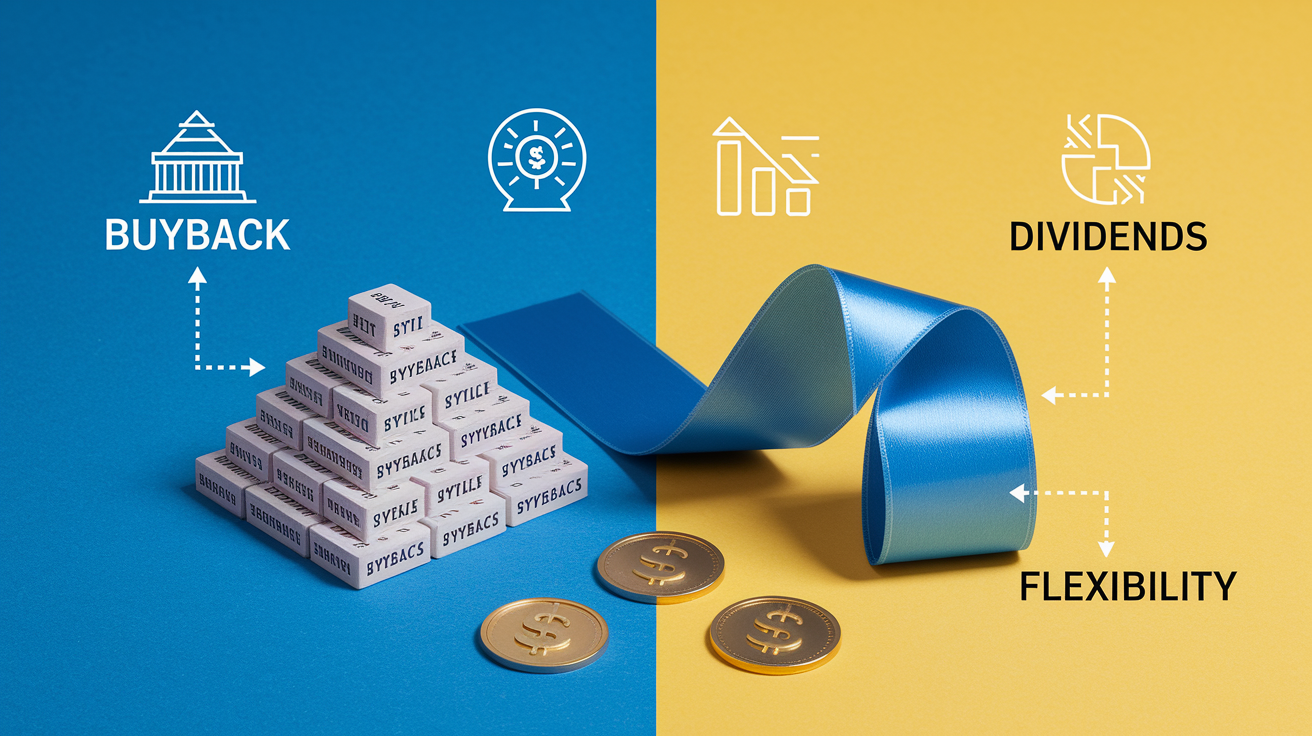
Buybacks and dividends both return cash to shareholders, but they differ in tax treatment, flexibility, and signaling. Dividends provide immediate, taxable income to all shareholders and carry an implicit commitment. Once established, cutting a dividend triggers a sharp negative reaction, so companies treat dividends as sticky obligations. Buybacks are tax deferred for shareholders who don’t sell, and they offer management discretion to start, stop, or adjust the pace of repurchases without the same stigma. This flexibility makes buybacks attractive in uncertain environments, but it also allows companies to prioritize timing over consistent capital return.
From an EPS perspective, buybacks deliver faster accretion because they reduce the share count, mathematically lifting earnings per share even when total earnings are flat. Dividends don’t change the denominator in the EPS calculation, so they provide income without the optical boost to growth metrics. Tax implications also diverge. Qualified dividends are taxed at capital gains rates, but the tax is due immediately, whereas buybacks allow shareholders to defer taxes until they sell and potentially benefit from lower long term capital gains treatment. For investors in tax advantaged accounts or those planning to hold indefinitely, the tax difference may be less relevant, but for taxable accounts the deferral advantage of buybacks can be significant.
Key comparison points to weigh when evaluating capital return announcements:
Flexibility vs commitment. Buybacks can be paused without market penalty. Dividends create an expectation of consistency and cuts trigger sell-offs.
Tax efficiency. Buybacks defer taxes and allow selective realization. Dividends trigger immediate taxable events for all holders.
EPS impact. Buybacks mechanically raise EPS by shrinking share count. Dividends don’t alter per share earnings but provide direct cash income.
Case Studies Illustrating Real World Buyback Announcement Impact
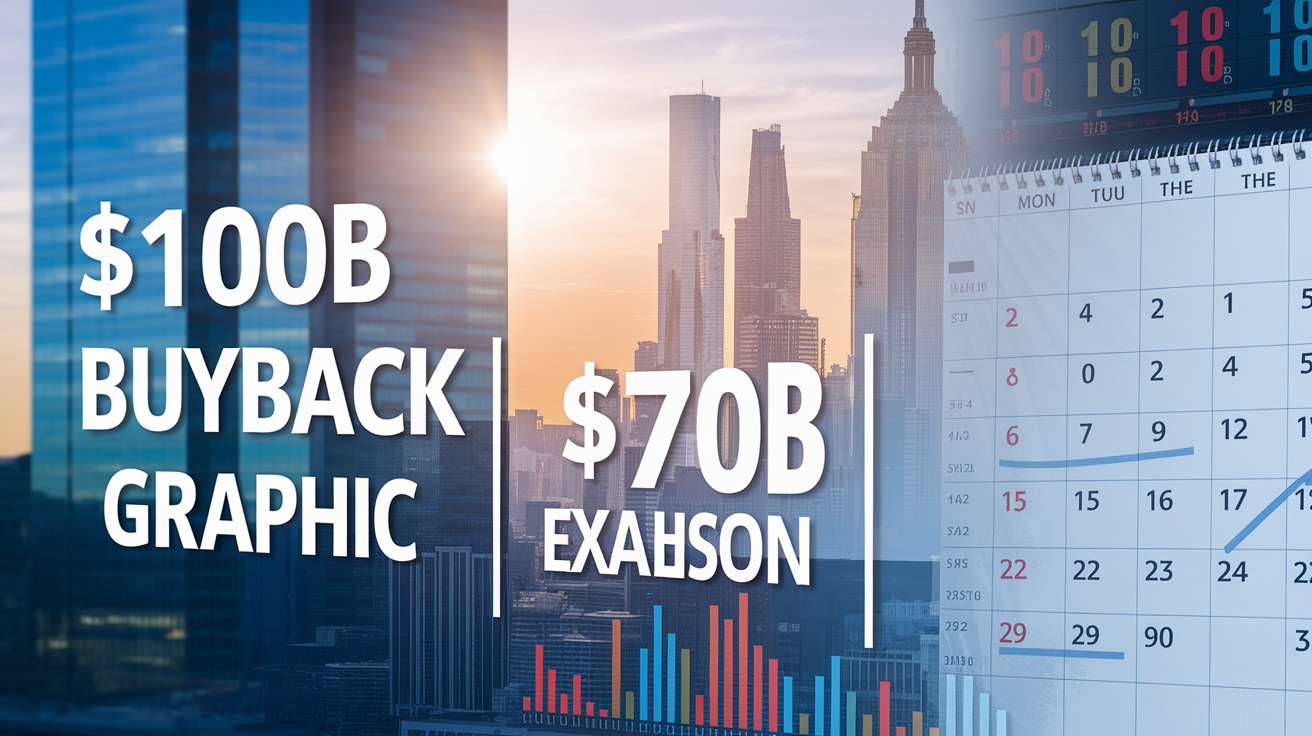
Large cap technology and consumer companies have provided some of the most visible examples of massive buyback announcements and their market effects. In 2024 and into 2025, one major company expanded its repurchase authorization by $100 billion, and another added $70 billion, together accounting for roughly 12 percent of the year’s total buyback announcements across U.S. markets. Both announcements lifted share prices within hours, as investors interpreted the capital commitments as signals of confidence and durability. One company’s $110 billion authorization in 2024 drew scrutiny when analysts noted that revenue growth had been flat over the prior five years since 2018, raising questions about whether the buyback masked stagnation rather than reflecting genuine strength.
Political and election year timing has historically influenced buyback activity and market performance. Companies often ramp up repurchase programs during re-election years, when regulatory and fiscal policy tends to favor stability and markets typically deliver above average returns. In 2024, heightened buyback activity aligned with the election calendar, creating a cycle where corporate buying supported broader market gains and amplified the S&P 500’s performance. This pattern reflects strategic timing. Management teams aware that favorable sentiment and media attention can magnify the impact of their announcements cluster buybacks around periods when investor appetite is strongest.
Tactical pre announcement buybacks illustrate how companies can engineer short term price gains. In documented cases, firms have repurchased shares in the weeks leading up to major product launches or earnings beats, then either slowed buying or allowed insiders to sell into the post announcement rally. One scenario described in market analysis involves overbuying shares to attract algorithmic and momentum buyers, then offloading those shares to new investors at elevated prices. A cycle that benefits management and early sellers but leaves late entrants holding shares purchased near peaks. These tactical maneuvers underscore the importance of scrutinizing execution timing and insider trading patterns alongside headline authorization figures.
Cross border contrasts add nuance to understanding announcement impact. In markets with different tax regimes, ownership structures, and regulatory frameworks, buyback announcements can produce varied reactions. In jurisdictions where dividends are taxed more heavily, buybacks may receive a more enthusiastic response from investors seeking tax efficient returns. In markets with stricter disclosure and anti manipulation rules, the signaling value of a buyback may be clearer because investors have more confidence that the program reflects genuine undervaluation rather than short term stock price management.
| Case | Key Impact |
|---|---|
| $100B and $70B expansions (2024–2025) | Together ~12% of annual U.S. buyback total; immediate price lifts and signaling of long term capital return commitment. |
| $110B authorization amid flat 5 year revenue | Raised investor concerns about financial engineering vs genuine growth; muted long term price response despite large headline figure. |
| Election year buyback clustering | Buybacks timed to favorable political cycles amplified market returns and attracted momentum buyers; above average S&P 500 performance in re-election years. |
| Pre product launch tactical buying | Companies repurchased before announcements, then slowed or sold into rallies; benefited insiders and early sellers but left late buyers at elevated prices. |
Final Words
Shares often pop on announcement day because buybacks signal confidence and cut share supply. We covered one-day lifts, EPS optics, motives, size and timing, and longer-run liquidity and execution gaps.
Here’s what to do: add announcements to your watchlist, check funding and buyback size, watch earnings and calendar timing, and use entry and stop levels. Treat a buyback like a catalyst, not a promise.
If you focus on the drivers we laid out, you’ll read the stock buyback announcement impact more clearly and make smarter trades. There’s opportunity ahead.
FAQ
Q: What immediate price reaction should I expect from a buyback announcement?
A: The immediate price reaction to a buyback announcement is usually a short-term lift as reduced supply and management confidence draw buyers; watch volume spikes and next-day follow-through for confirmation or quick reversals.
Q: How do buyback announcements change financial statements and ratios?
A: Buyback announcements change financial statements by reducing cash, assets, and shareholders’ equity, which often boosts EPS, ROE, and ROA mechanically because net income is spread across fewer shares.
Q: Why do markets interpret buybacks as a positive signal and when might they not?
A: Markets interpret buybacks as a confidence signal because management returns cash, but they may not be positive if used to mask weak operations or enrich insiders; look for funding source and valuation to judge intent.
Q: How should investors evaluate buyback size, timing, and funding?
A: Investors should evaluate buyback size versus cash and market cap, timing around earnings or elections, and funding—cash is cleaner, debt-funded buybacks raise balance-sheet risk and deserve smaller position sizes.
Q: How do you measure announcement impact using an event study?
A: You measure announcement impact by calculating cumulative abnormal returns (CAR) over a chosen event window, adjusting for market factors, testing statistical significance, and comparing different windows for robustness.
Q: What are the long-run effects on performance, liquidity, and volatility after buybacks?
A: Long-run effects can include modest performance gains, reduced market liquidity, and mixed volatility; many programs aren’t fully executed, so long-term benefits depend on execution and capital allocation priorities.
Q: How do buybacks compare to dividends for shareholder benefits?
A: Buybacks compare to dividends by often being more tax-efficient and faster at boosting EPS, while dividends provide steady income; weigh tax status, need for cash, and whether buybacks divert from investment.
Q: What real-world patterns and red flags do buyback case studies show?
A: Real-world cases show mega-cap authorizations, pre-news buying, and political-cycle timing; red flags include heavy debt funding, buying at high valuations, and large gaps between announced and executed repurchases.