
Want a shortcut to stocks that actually move?
Analyst upgrade catalysts are one of the fastest, most reliable triggers, if you know where to look.
You don’t need a paid terminal.
A few free market-data tools refresh before the bell and flag upgrades that big banks and top firms issue.
In this post you’ll get a step-by-step morning routine: where to scan, the signal rules (firm, size of target lift, clustering, timing), and the exact levels that mean “trade” or “stand aside.”
By the end you’ll have a watchlist-building plan you can use in 10 minutes.
Identifying Analyst Upgrades Using Market‑Data Tools
You don’t need a Bloomberg terminal to find fresh analyst upgrades. A few free platforms update their logs every morning before the bell, and once you know where to look, you can build a reliable daily watchlist in minutes.
Yahoo Finance is the easiest place to start. Pull up any ticker, hit the “Analysis” tab, and scroll down to “Upgrades & Downgrades.” You’ll see a table with the date, the firm, what they did (upgrade, downgrade, initiation, reiteration), the old rating, the new one, and the new price target. It updates overnight, so by 7 a.m. Eastern you’re seeing everything that moved. Finviz does something similar under its “Screener” tab. Click “Analyst Ratings” and it spits out every ticker that got a rating change in the last week, plus the firm name and the direction. MarketWatch lists them under “Market Data” in the “Analyst Ratings” section, refreshed each morning. CNBC buries them in the pre-market briefing and on individual stock pages.
Here’s how to actually use these tools every morning:
- Open Finviz’s screener around 6:30 a.m. Eastern and filter by “Analyst Ratings” to catch everything from the last 24 hours.
- Check Yahoo Finance’s upgrade section for tickers you’re already tracking or ones that pop up in your scans.
- Look at who issued the call. Goldman Sachs, Morgan Stanley, JP Morgan, Citi, and Bank of America move prices way more than boutique shops.
- Write down the new price target and compare it to where the stock’s trading now. A $20 target on a $15 stock is interesting. A $16 target? Not so much.
- Double check the timestamp. Some platforms label yesterday afternoon’s call as “today,” so pull up the intraday chart and make sure the move didn’t already happen.
- Add tickers with credible firms, big target lifts, and no overnight gap to your watchlist. Then watch what happens at the open.
Most platforms refresh between 5 a.m. and 7 a.m. Eastern. Building this into your morning routine gives you time to read the reasoning, check the chart, and decide if you’re trading the open or waiting for confirmation.
Key Indicators That Strengthen an Analyst Upgrade Catalyst

Not every upgrade matters. The market cares about upgrades that pair a big price target revision with solid timing and sector momentum. When some boutique firm raises its target by two bucks, nobody notices. But when Morgan Stanley lifts a target by 30 percent two weeks before earnings and three other analysts just did the same thing? That’s a cluster worth watching.
The upgrades that actually move stocks share five things. First, the size of the price target increase. A jump from $50 to $75 gets attention and gives momentum traders room to run. $50 to $52 barely registers. Second, firm reputation. Upgrades from the big banks that lead IPOs and advise on M&A carry weight. Regional shops don’t. Third, sector momentum. An upgrade in AI infrastructure or weight loss drugs finds ready buyers. An upgrade in a dying industry fights the tape. Fourth, clustering. When three or four firms upgrade the same name within two weeks, institutions notice and start adding exposure. Fifth, timing near a catalyst. Earnings, product launches, FDA decisions. These give the upgrade a concrete event to validate the new target and keep buying pressure going for days or weeks.
What to look for specifically:
- Size of price target increase: A 20 percent lift or more creates room for the stock to run and pulls in algorithmic momentum strategies.
- Firm reputation: Goldman, JP Morgan, Morgan Stanley, Citi, Bank of America. They move prices faster and further.
- Sector momentum: Upgrades in hot sectors benefit from existing buying interest and media coverage.
- Upgrade clustering: Multiple analysts upgrading in a short window suggests a broad re-rating and reduces single analyst risk.
- Earnings proximity: Upgrades one to three weeks before earnings often anticipate a beat and generate follow through if results confirm the call.
Screening for Stocks Likely to Receive Analyst Upgrades Soon
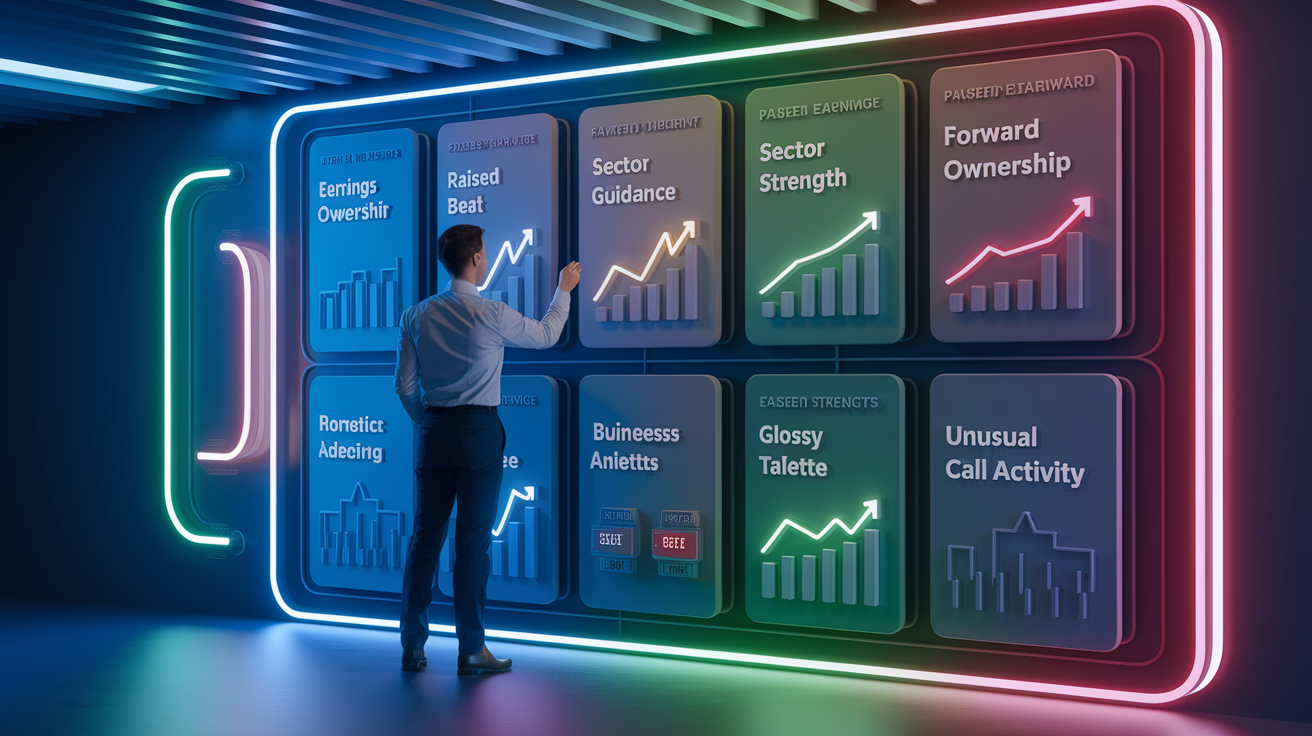
Analyst upgrades aren’t random. They follow patterns tied to earnings beats, raised guidance, margin expansion, positive supply chain data, competitive shifts. Track these indicators and you can build a list of candidates likely to get upgraded in the next few weeks. Then position before the call hits.
Start with earnings beats that surprise by at least 10 percent on revenue or EPS. Analysts update models right after a beat, and upgrades often follow within 48 hours as they adjust full year estimates. Raised guidance is an even stronger signal. When management lifts forward earnings or revenue guidance on the call, cautious analysts often upgrade to reflect the new outlook. Sector strength matters too. If three competitors all beat in the same week, analysts frequently upgrade the remaining names expecting similar results. Rising institutional ownership shows up in quarterly 13F filings. When large funds are accumulating shares ahead of a re-rating, analysts notice. And unusual call option activity, especially out of the money strikes expiring in the next month, sometimes precedes upgrades as traders position for a catalyst they expect soon.
| Indicator | Why It Suggests an Upcoming Upgrade |
|---|---|
| Earnings beat by 10%+ | Forces analysts to revise models upward and often triggers immediate rating changes within 24 to 48 hours |
| Raised forward guidance | Management confidence signals sustainable improvement. Analysts upgrade to align with new targets |
| Sector wide strength | When peers beat, analysts often upgrade laggards expecting similar results at the next report |
| Rising institutional ownership | 13F filings showing new positions by top funds suggest re-rating ahead. Analysts follow smart money |
| Unusual call option activity | Out of the money call volume spikes can indicate informed positioning before a known catalyst or upgrade leak |
When you see two or more of these on the same ticker, the probability of an upgrade goes up. Stock beat earnings, raised guidance, and shows a 20 percent jump in institutional ownership? Put it on your watchlist and watch for the announcement.
Timing Strategies for Trading Analyst Upgrade Catalysts
Stocks move fastest in the first 15 to 90 minutes after an upgrade. Algorithms and momentum desks react instantly. By the time you see the headline on Twitter, the initial pop may be done. If you’re trading the immediate reaction, you need to be ready before the bell or within the first few minutes. Use limit orders near the prior close or the pre-market high. Don’t chase a runaway gap.
Multi day continuation happens when the price target rises by 20 percent or more and the upgrade comes from a top tier firm. The stock often pulls back slightly in the first hour as early buyers take profits, then resumes over the next two to five sessions as institutions build positions and retail discovers the story. Swing traders can wait for the first pullback to support (usually the prior day’s high or a key moving average) and enter there with a stop just below. If the upgrade includes a near term catalyst like earnings in two weeks or a product launch next month, holding through that event can capture a larger move. But set a profit target and a trailing stop to protect gains if the catalyst disappoints.
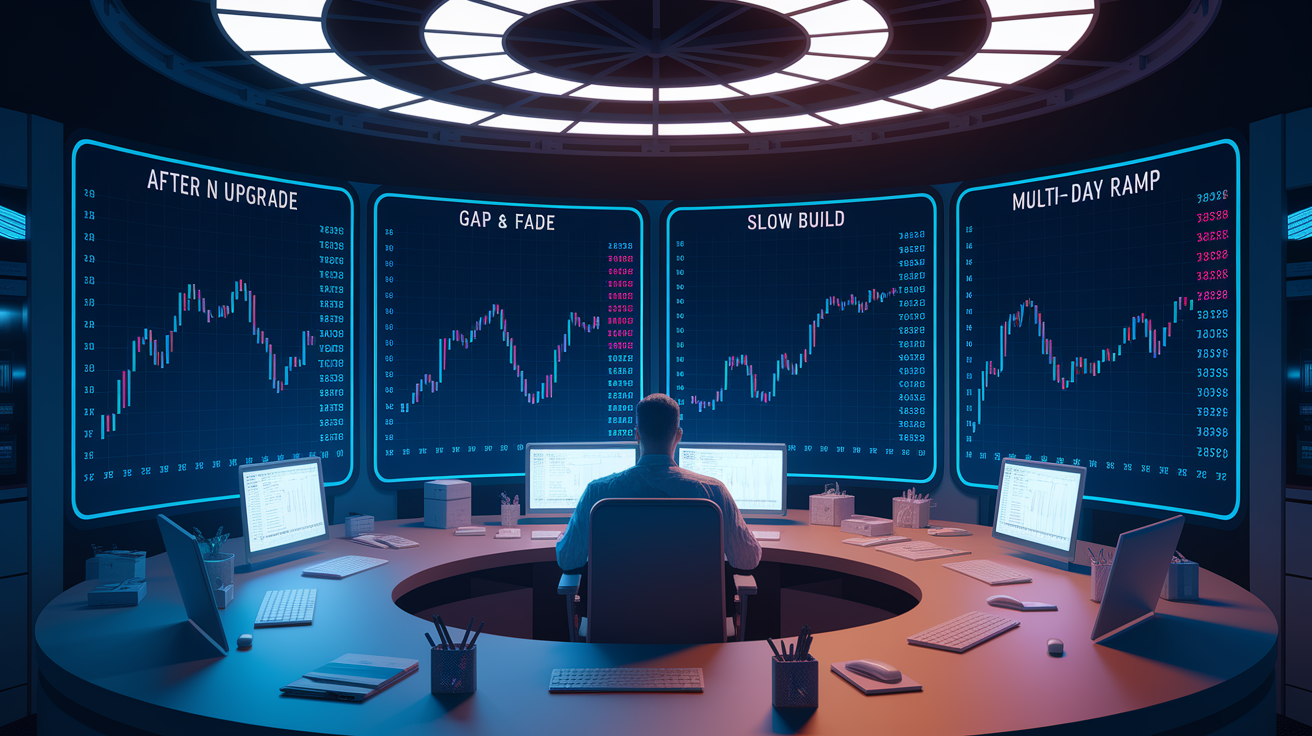
Four common reaction patterns:
- Immediate gap and fade: Stock gaps up 5 to 10 percent at the open, peaks in the first 30 minutes, then drifts lower as profit takers exit. Trade this by selling into the early spike or staying out.
- Gap and continuation: Stock gaps up and holds the gap all day, often closing near the high. Enter on the first intraday pullback or on a shallow dip the next morning.
- Slow build: No gap, but the stock trends higher all session as the upgrade circulates. Enter early if volume confirms, or wait for a breakout above prior resistance.
- Multi day ramp: Stock rallies modestly on day one, then continues for three to five sessions as institutions accumulate. Best traded by entering on the first day’s close or the next morning’s dip, holding with a trailing stop.
Match your timing to your holding style. Scalpers take the first 15 minutes. Day traders take the first session. Swing traders hold two to five days if the setup confirms.
Examples of Analyst Upgrade Catalysts and Market Reactions

On May 10, 2016, Pacific Crest upgraded Nvidia from “Sector Perform” to “Outperform” and raised its price target from $32 to $40, citing accelerating data center GPU adoption. Nvidia closed the prior session at $31.50. It gapped to $33 at the open, held the gap all day, and closed at $33.80. Up 7.3 percent on volume nearly triple the daily average. Over the next five sessions, the stock continued to $37. A cumulative move of more than 17 percent from the close before the upgrade, as other analysts followed with their own upgrades and institutional buying sustained momentum.
On October 23, 2019, Wedbush upgraded Tesla from “Neutral” to “Outperform” and lifted its price target from $220 to $370, highlighting improving Model 3 production and the China factory ramp. Tesla closed at $254 the day before. It gapped to $265 at the open, pulled back to $260 mid morning as early sellers took profits, then resumed and closed at $270. Up 6.3 percent. The stock consolidated around $270 for two days, then continued to $310 over the next two weeks, fueled by additional upgrades and a positive earnings surprise on October 23. Multi day continuation delivered a 22 percent gain from the pre-upgrade close to the peak.
On February 2, 2023, Bank of America upgraded Meta from “Neutral” to “Buy” and raised its price target from $135 to $180, citing improving ad revenue trends and cost discipline. Meta closed at $149 the prior day. The upgrade hit before the bell. Meta gapped to $155 at the open, spiked to $158 in the first hour on heavy volume, then settled at $156 by the close. Up 4.7 percent. Over the next three sessions, the stock climbed to $168 as momentum traders and institutional desks added exposure ahead of earnings. The move held through the earnings report, delivering a cumulative 12.8 percent gain from the pre-upgrade close to the post earnings high.
On June 8, 2020, Piper Sandler upgraded Zoom from “Neutral” to “Overweight” and raised its price target from $150 to $250, pointing to sustained enterprise adoption and work from home tailwinds. Zoom closed at $214 the day before. It gapped to $225 at the open, ran to $232 by mid morning, pulled back to $228 by the close, and finished up 6.5 percent. The rally continued for four more sessions, reaching $260 by June 12. A 21.5 percent move from the pre-upgrade close, as additional analysts raised targets and retail interest surged around the remote work theme.
Evaluating Analyst and Firm Credibility

Not all analyst upgrades deserve your attention or your money. Some firms have track records of accurate calls and realistic price targets. Others issue upgrades that look more like marketing for investment banking clients than independent research. Before you trade an upgrade, spend two minutes checking the firm’s reputation, the analyst’s history, and whether the call makes sense given the stock’s fundamentals and chart.
Start with the issuing firm. Bulge bracket banks like Goldman Sachs, Morgan Stanley, JP Morgan, Citi, and Bank of America have large research teams, institutional distribution, and accountability. Their upgrades move prices because they reach the desks that move real money. Independent research firms like Evercore, Bernstein, and Piper Sandler carry weight too, especially in sectors where they have deep expertise. Check the analyst’s track record next. Several ranking services score analysts on accuracy and returns. A quick search for the analyst’s name plus “track record” or “ranking” usually surfaces that data. Third, read the price target and ask if it’s realistic. A $50 target on a $40 stock trading at 15 times earnings is plausible. A $100 target on the same stock with no clear catalyst is hype. Watch for conflicts of interest. If the firm recently underwrote the company’s debt or advised on an acquisition, the upgrade may reflect that relationship more than objective analysis. Finally, review the firm’s historical performance in the sector. A firm with a strong record in biotech carries more weight upgrading a drug stock than a generalist shop covering 30 industries.
What to verify:
- Accuracy track record: Look for analysts or firms ranked in the top quartile by services that score calls based on price performance over 6 and 12 months.
- Institutional tier: Bulge bracket and respected independent firms have broader distribution and accountability. Their calls move institutional money.
- Price target realism: Compare the new target to current valuation multiples, growth rates, and peer comps. Aggressive targets with no catalyst are red flags.
- Conflict of interest concerns: Check whether the firm has investment banking, underwriting, or advisory relationships with the company that might bias the research.
- Historical sector performance: Firms with deep sector expertise and a history of early, accurate calls in that space carry more credibility than generalists issuing scattered upgrades.
Final Words
We covered where to find real-time upgrade logs, which signals make an upgrade meaningful, how to spot pre-upgrade clues, timing strategies, and how to vet the analyst.
Now do this: build a watchlist, check Finviz’s Analyst Ratings and Yahoo Finance’s Upgrades page daily, note rating change, new price target, and firm, and watch for cluster moves and volume spikes.
Start small and size for volatility. This is how to find stocks with analyst upgrade catalysts and trade them with a clear entry, stop, and profit plan, so you’re ready to act with confidence.
FAQ
Q: How do I locate analyst upgrades on Finviz and Yahoo Finance?
A: To locate analyst upgrades on Finviz and Yahoo Finance, open Finviz Screener → Analyst Ratings, or Yahoo Finance → Ticker → Analysis → Upgrades; check rating change, new price target, and analyst firm.
Q: What indicators make an analyst upgrade meaningful?
A: An analyst upgrade is meaningful when it shows a large price‑target increase (about 15%+), multiple firms upgrade together, institutional buying is visible, the firm has a strong reputation, and sector momentum supports it.
Q: How can I screen for stocks likely to receive upgrades soon?
A: You can screen for likely upgrades by watching for earnings beats, raised guidance, sector strength, rising institutional ownership, unusual call‑option activity, plus spikes in volume or falling short interest as early hints.
Q: What timing strategies should I use to trade upgrade catalysts?
A: Use timing strategies that watch the first 15–90 minutes for the sharpest moves, wait for a confirmation candle before entry, plan multi‑day scaling if it holds, and set clear invalidation stops.
Q: How big must a price‑target revision be to matter?
A: A price‑target revision usually matters when it rises roughly 15 percent or more; smaller changes can still matter if multiple analysts move together or the issuing firm is top‑tier.
Q: How do I evaluate an analyst or firm’s credibility?
A: Evaluate credibility by checking the analyst’s past accuracy, the firm’s institutional tier, realism of the price target, any conflict disclosures, and historical performance in the sector covered.
Q: What should I watch after an upgrade for confirmation or failure?
A: After an upgrade, watch for a volume spike with follow‑through price strength, rising institutional activity, a clean break above resistance for confirmation, or a drop below support to invalidate it.
Q: How often do major platforms update upgrade logs?
A: Major platforms update upgrade logs at least daily; many publish same‑day or near‑real‑time entries for notable moves and often offer alerts or feeds for new upgrades.
Q: How should I use analyst upgrades in my watchlist and trade plan?
A: Use upgrades to add names to a watchlist, set an entry on confirmation, size positions for volatility, plan profit‑taking areas, and place an explicit stop at the declared invalidation level.