One FDA yes or no can wipe out a company — or hand early buyers a huge pop.
We mapped the next PDUFA calendar and pulled the top names traders should watch: UTHR, PRVT, NTLA and NVO among others.
This piece turns those dates into a simple game plan: what the catalyst is, which tickers to watch, and the key levels that confirm a trade.
Read on for clear entry ideas, stop triggers, and the one thing that would make us step back.
Upcoming FDA Decision Calendar
A live calendar of upcoming PDUFA dates is one of the most useful tools you can have if you trade biotech stocks. These dates mark when the FDA must make a final decision on whether to approve a new drug. The review period typically runs six months for priority review or ten months for standard review, starting from the date the FDA accepts the application. Below is a current snapshot of major decisions expected over the next six months.
| Ticker | Company | Drug | Indication | PDUFA Date |
|---|---|---|---|---|
| NVO | Novo Nordisk | Fiasp (insulin aspart) | Type 2 diabetes | 2026-09-29 |
| UTHR | United Therapeutics | Ralinepag | Pulmonary arterial hypertension | 2026-08-15 |
| ATRA | Atara Biotherapeutics | Tab-cel | Post-transplant complications | 2026-10-22 |
| OCU | Ocugen | OCU400 | Retinitis pigmentosa | 2027-Q1 |
| PRVT | Priovant Therapeutics | Brepocitinib | Dermatomyositis | 2026-07-10 |
| NTLA | Intellia Therapeutics | Nexiguran ziclumeran | ATTR-CM | 2026-11-03 |
| LNTH | Lantheus Holdings | Lutetium Lu 177 Dotatate (PNT2003) | Neuroendocrine tumors | 2026-09-05 |
| HROW | Harrow | TRIESENCE 40 mg/mL | Post-cataract inflammation | 2027-Q2 |
Keep in mind that these dates can shift. The FDA has the authority to extend its review for three additional months if it identifies issues that require more time, or if the sponsor submits significant new data late in the cycle. Companies will usually file an 8-K to disclose any formal extension notice. If you’re planning a trade around one of these events, watch for any FDA communication about sixty days before the target date. That’s when the agency sometimes signals delays.
High Impact FDA Decisions to Watch

Not all FDA decisions move stocks the same way. The size of the move depends on how big the addressable patient population is, whether the drug is first in class, and how much uncertainty the Street is pricing in. A small cap company with one product and a huge unmet need can see triple digit swings. A megacap with dozens of drugs already on the market might barely move even on a blockbuster approval.
United Therapeutics Ralinepag for Pulmonary Arterial Hypertension
United Therapeutics filed ralinepag for pulmonary arterial hypertension after its ADVANCE OUTCOMES Phase 3 trial showed a 55 percent reduction in the risk of clinical worsening versus placebo. The hazard ratio came in at 0.45 with a 95 percent confidence interval of 0.33 to 0.62 and a p value under 0.0001. Those numbers are about as clean as you can get in a cardiovascular outcome trial.
The addressable market here is meaningful. PAH is a rare and progressive disease, but peak sales estimates for ralinepag cluster around 850 million dollars, depending on how aggressively the company prices it and how quickly it gains share from existing therapies. The Street is treating this as a high probability approval, somewhere in the 75 to 85 percent range. The main risk is whether the FDA asks for additional cardiovascular safety data or demands label restrictions that narrow the eligible population. If the approval is clean and the label is broad, expect a single digit percentage move for UTHR given its size. If the agency delays or issues a complete response letter, you could see a quick drop of 8 to 12 percent.
Priovant Brepocitinib for Dermatomyositis
Priovant submitted its NDA for brepocitinib in dermatomyositis and received priority review, which shortens the clock to six months. This is a first in class oral therapy targeting a rare inflammatory muscle disease with no approved therapies. That profile makes it a binary event with asymmetric upside.
The company is small, so approval would validate the entire clinical platform and open the door to partnership or acquisition interest. Peak sales estimates are more conservative here, in the 250 to 400 million dollar range, but relative to Priovant’s market cap the approval would be material. Approval probability sits around 60 to 70 percent. The uncertainty comes from the fact that the pivotal trial was a single study in a rare indication, and the FDA sometimes asks for confirmatory data in those cases. Watch for any advisory committee scheduling. If the agency calls one it usually means the risk benefit profile is being debated internally. If brepocitinib clears without restrictions, the stock could move 30 to 50 percent on the news. A delay or complete response letter would likely trigger a 40 to 60 percent drop.
Intellia Nexiguran Ziclumeran for ATTR CM
Intellia got the FDA to lift a clinical hold on its MAGNITUDE Phase 3 trial for nexiguran ziclumeran, a gene editing therapy for transthyretin amyloid cardiomyopathy. The removal of the hold is a positive signal, but the PDUFA date is still months out and depends on how the final efficacy and safety data look when the trial completes.
This is a high stakes program because ATTR CM is a fatal disease and existing therapies only slow progression. A one time gene edit that halts or reverses the disease would command premium pricing and generate billions in peak sales. The Street is cautious here, pricing in approval odds around 50 to 60 percent, because the therapy is first generation CRISPR and any unexpected safety signal could derail it. If the trial hits its primary endpoint and the FDA grants approval, Intellia’s valuation could re rate sharply higher, potentially 60 to 100 percent in the weeks following the decision. A miss on efficacy or a serious adverse event would cut the stock by 50 percent or more.
Historical Market Reaction to FDA Decisions

Biotech stocks react fast and hard to FDA decisions because most clinical stage companies have little or no revenue, so a single approval or rejection can change the entire investment thesis overnight.
When a drug wins approval, especially a first in class therapy or a drug targeting a large unmet need, the stock often pops 20 to 80 percent on the day of the announcement. Rejections or complete response letters tend to produce drops in the 30 to 70 percent range, depending on whether investors were pricing in high odds of success. Here are four real examples from the last five years that show the range.
In 2019, the FDA approved Biogen’s aducanumab (later Aduhelm) for Alzheimer’s disease under the accelerated approval pathway. The stock jumped approximately 38 percent on the news, even though the approval came with significant controversy and a requirement for post market studies.
When the FDA issued a complete response letter to Acadia Pharmaceuticals for trofinetide in Rett syndrome in early 2023, the stock fell roughly 28 percent in a single session. The rejection centered on the need for additional clinical data.
Sarepta Therapeutics saw its shares rise about 29 percent in June 2023 when the FDA approved its gene therapy for Duchenne muscular dystrophy, a rare genetic disorder with high unmet need and multi billion dollar revenue potential.
In 2021, when the FDA rejected Cassava Sciences’ application for a cognitive disorder therapy due to data integrity concerns, the stock dropped more than 40 percent intraday and continued to drift lower over the following weeks.
Predicting the exact size of the move is tough because it depends on how much the decision was already priced in, how liquid the stock is, and whether the approval comes with label restrictions or post market requirements. A binary event is only truly binary if the market was genuinely uncertain going in. If everyone expects approval and it happens, the pop might be muted. If the Street is pricing in failure and the drug clears, the move can be explosive.
Company Specific Deep Dives

Below are detailed profiles of three companies with major FDA decisions on the horizon. Each has a unique risk reward setup and different catalysts driving the stock.
United Therapeutics (UTHR)
United Therapeutics is a well established player in pulmonary arterial hypertension, with multiple approved therapies already generating over two billion dollars in annual revenue. The upcoming PDUFA decision for ralinepag is important because it would add a new oral option to the portfolio and extend the company’s dominance in PAH.
The ADVANCE OUTCOMES trial data was strong. A 55 percent reduction in clinical worsening with a clean safety profile gives the FDA little reason to delay, unless the agency wants more long term cardiovascular outcomes data. The company has deep regulatory experience and a track record of navigating label negotiations successfully. If ralinepag is approved with a broad label, it should ramp quickly because United already has the sales force and payer relationships in place.
Key investment risks to consider:
The FDA could restrict the label to a narrower patient subset, limiting peak sales. Competitive pressure from newer PAH therapies could slow uptake even if the drug is approved. Any manufacturing or quality issues flagged in the approval letter could delay the commercial launch.
Priovant Therapeutics (PRVT)
Priovant is a clinical stage biotech with brepocitinib as its lead asset. The drug is an oral JAK1 inhibitor being developed for dermatomyositis, a rare inflammatory disease that causes muscle weakness and skin rashes. There are no FDA approved therapies for this indication, so brepocitinib would be first to market.
The company filed under a priority review designation, which signals the FDA views this as addressing a serious condition with inadequate treatment options. The pivotal trial met its primary endpoint on muscle strength and skin improvement, and the safety profile was manageable. The main uncertainty is whether the FDA will ask for a second confirmatory trial before granting full approval, or whether it will approve conditionally with post market requirements.
Key investment risks to consider:
A single pivotal trial in a rare disease can trigger requests for additional data, leading to a complete response letter. Pricing and reimbursement could be challenging if payers demand real world evidence before coverage. The company has limited cash runway, so a delay could force dilutive financing.
Intellia Therapeutics (NTLA)
Intellia is a gene editing company using CRISPR technology to develop one time treatments for genetic diseases. Nexiguran ziclumeran targets transthyretin amyloid cardiomyopathy, a fatal condition caused by the buildup of misfolded proteins in the heart. The FDA lifted a clinical hold on the MAGNITUDE Phase 3 trial earlier this year, which was a positive signal that early safety concerns had been resolved.
The market opportunity here is significant. ATTR CM patients face high mortality and current therapies only slow disease progression. A curative gene edit would command premium pricing, potentially over 500,000 dollars per patient, and could generate peak sales exceeding two billion dollars. The challenge is that this is first generation CRISPR, and any unexpected immune response or off target editing events could derail the program. The FDA will scrutinize the long term safety data closely.
Key investment risks to consider:
Gene editing therapies face higher regulatory hurdles due to permanence and unknown long term effects. Manufacturing complexity could delay approval or limit commercial scalability. Competitive programs from other gene editing companies could compress pricing or market share assumptions.
How to Monitor FDA Updates
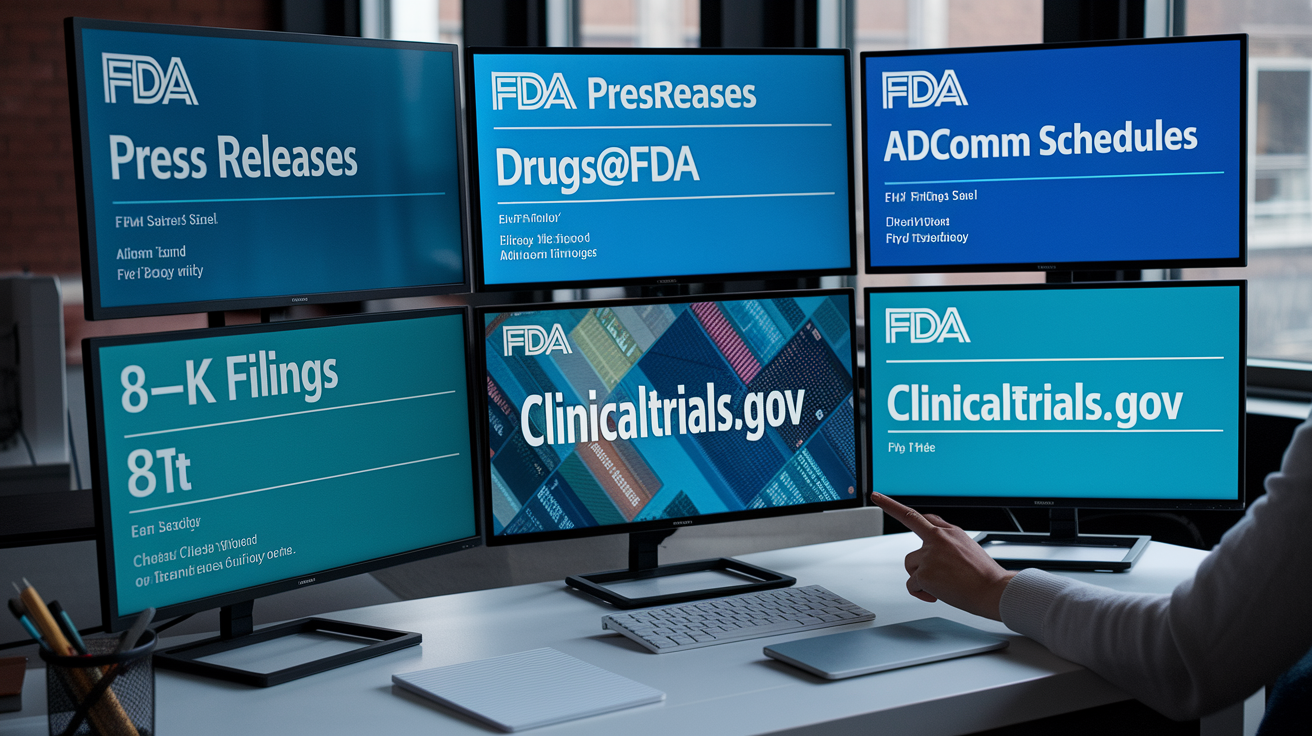
The FDA publishes its decisions and regulatory updates in several places, and knowing where to look can give you an edge on timing. Official approvals and complete response letters are usually announced via FDA press releases posted on the agency’s website, often early in the morning Eastern time. You can also track drug status changes through the Drugs@FDA database, which is updated in near real time when a decision is made.
Here are five tools and what each one is used for:
FDA press releases. Official announcements of approvals, rejections, and safety alerts, posted on FDA.gov.
Drugs@FDA database. Searchable tool showing approval status, labels, and review history for all marketed drugs.
AdComm schedules. Lists upcoming advisory committee meetings, which signal the FDA wants external expert input on a borderline decision.
Company 8-K filings. SEC disclosures where companies report receipt of FDA action letters, PDUFA date changes, or meeting outcomes.
Clinical trial registries (ClinicalTrials.gov). Shows trial status, completion dates, and sometimes links to FDA correspondence on holds or amendments.
Markets react fast. A binary FDA decision can move a stock 30 percent or more in the first fifteen minutes of trading, especially for small and mid cap biotechs. If you’re trading around a PDUFA date, set alerts for FDA press releases and company disclosures, and be ready to act quickly once the news hits.
Final Words
In the action, this post gave a live FDA decision calendar, highlighted three high-impact catalysts, reviewed historical stock moves, offered deep dives on key companies, and showed how to monitor updates.
Use the calendar to build a tight watchlist and mark PDUFA dates as trade triggers. Focus on trial data and advisory committee signals. Size positions small and set clear entry, profit-taking, and stop levels.
If you’re tracking stocks with upcoming FDA approval decisions, be ready for big swings but trade with rules. Stay disciplined. There’s opportunity ahead.
FAQ
Q: What is the FDA decision calendar?
A: The FDA decision calendar is a live list of key PDUFA dates showing ticker, drug, indication, and decision date. Use it to build a watchlist, plan entries, and track late‑cycle catalysts.
Q: What is a PDUFA date?
A: The PDUFA date is the FDA’s target deadline for reviewing a drug application. Mark it, watch pre‑decision filings, and tighten risk controls one to two weeks before the date.
Q: How can FDA decisions move biotech stocks?
A: FDA decisions can move biotech stocks dramatically; approvals often spark 20–80 percent gains, while rejections can trigger 30–70 percent declines. Position small and expect high volatility around the date.
Q: How should I trade around a PDUFA date?
A: You should trade around a PDUFA date by defining an entry (buy zone), confirmation (positive news/break), invalidation (stop level), and profit targets; size positions small and use staggered entries.
Q: Where do FDA announcements appear and what tools should I use to monitor them?
A: FDA announcements appear in FDA press releases, Drugs@FDA, advisory committee docs, company press releases/SEC filings, and market newsfeeds; use those five tools to catch late‑cycle updates and label talks quickly.
Q: What approval probability ranges should I expect?
A: Approval probability ranges typically run from about 50 percent for mixed data up to 90 percent for strong, confirmatory trials. Use those odds to size positions and set realistic profit targets.
Q: Can PDUFA dates change and how often do extensions occur?
A: PDUFA dates can change; the FDA may extend reviews for more data or manufacturing questions. Keep the calendar live and watch for advisory committee scheduling or complete response letters.
Q: What events typically invalidate a bullish thesis ahead of a decision?
A: A bullish thesis is invalidated by missed primary endpoints, new safety signals, weak secondary outcomes, or regulator requests for more trials; if that happens, trim or close the position.
Q: How large should my position be before a binary FDA event?
A: Your position before a binary FDA event should be small—commonly 1–3 percent of portfolio value—because outcomes are binary and volatility is high; use stops and consider options for defined risk.
Q: How fast do markets react once an FDA decision is announced?
A: Markets react within minutes to hours after a decision, often with large gaps; preplan orders, avoid emotional chasing, and watch volume and price action for confirmation before adjusting positions.
Q: How should I use the FDA calendar to build a watchlist?
A: Use the FDA calendar to add tickers with upcoming PDUFA dates to a watchlist, rank by market impact and probability, set alerts two weeks before, and plan your entry and stop levels.